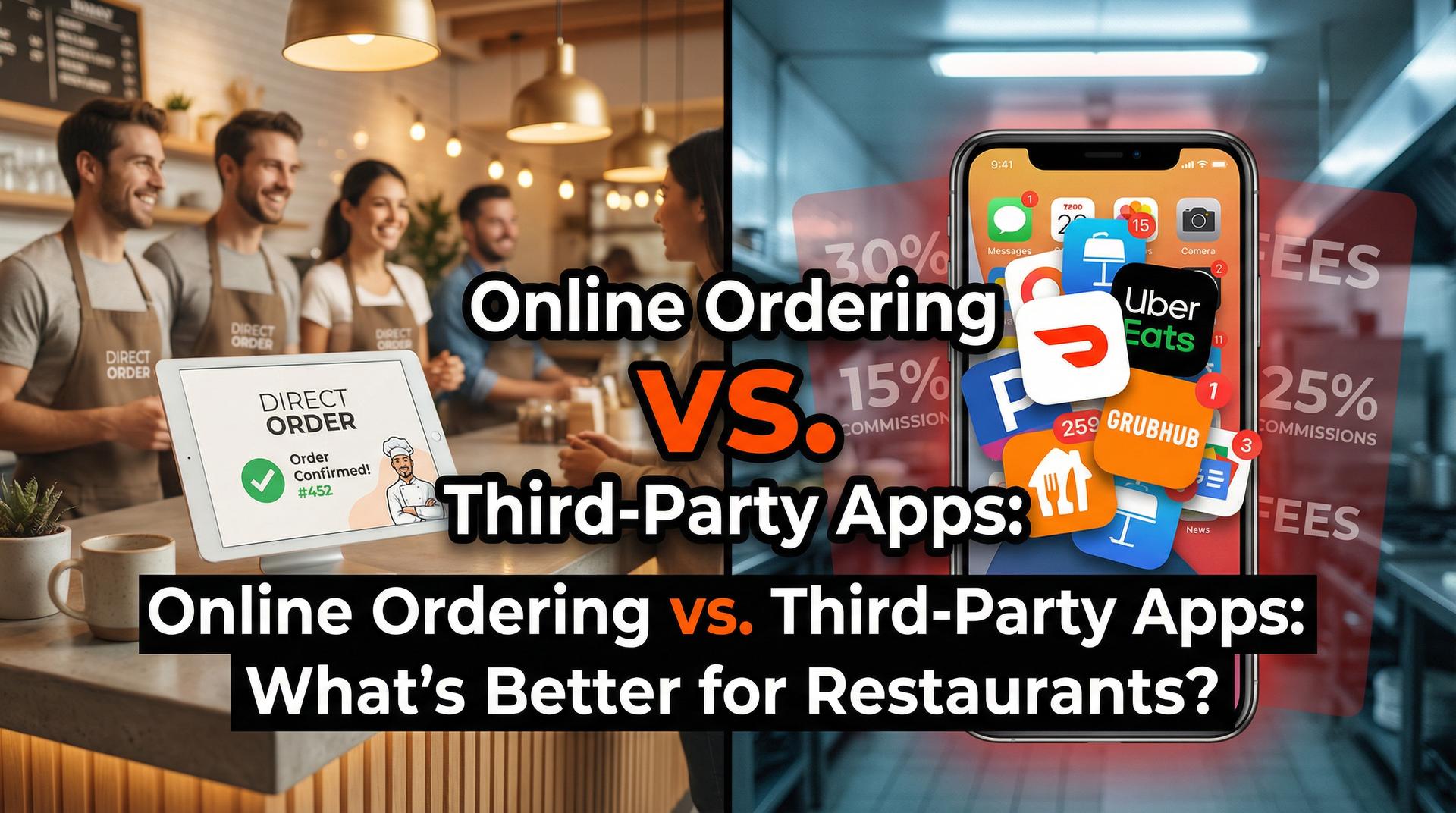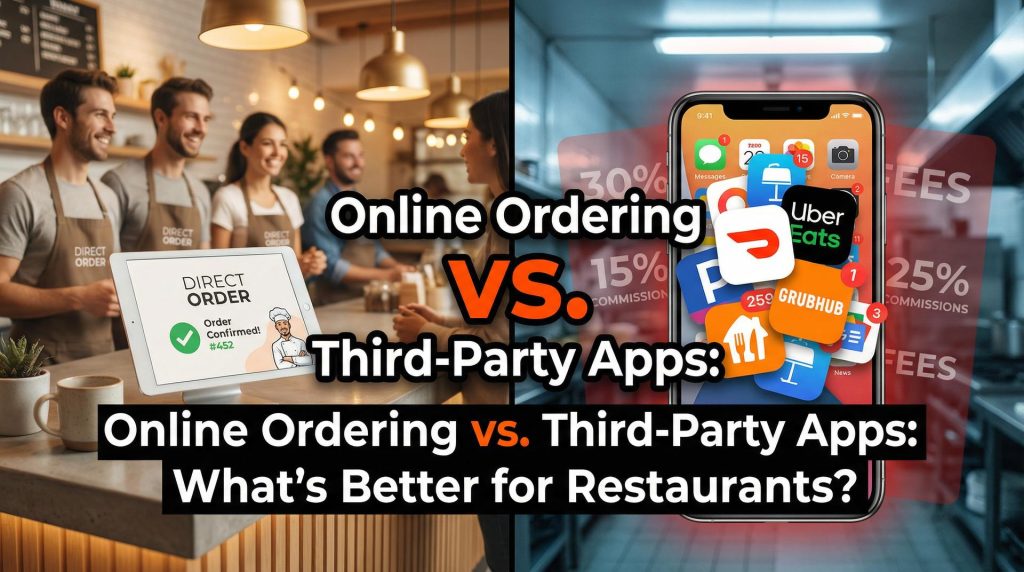
Actually, the choice between online ordering vs third party apps for restaurants can really make a huge difference in how exactly the business grows. It’s not all about getting more orders, but it’s about controlling profits, building customer loyalty, along with strengthening the brand over time.
Third-party apps provide quick reach as well as a steady stream of customers. However, they take significant commissions, control how exactly the restaurant is presented, and limit access to customers’ data. On the other hand, online ordering systems put the restaurant in control, and align every order to contribute in order to repeat business, better margins, and long-term growth.
In this blog, we’ll break down both approaches and provide actionable insights on which option is truly better for restaurants looking to grow sustainably.
Online Ordering vs Third Party Apps for Restaurants: What’s the Real Difference?
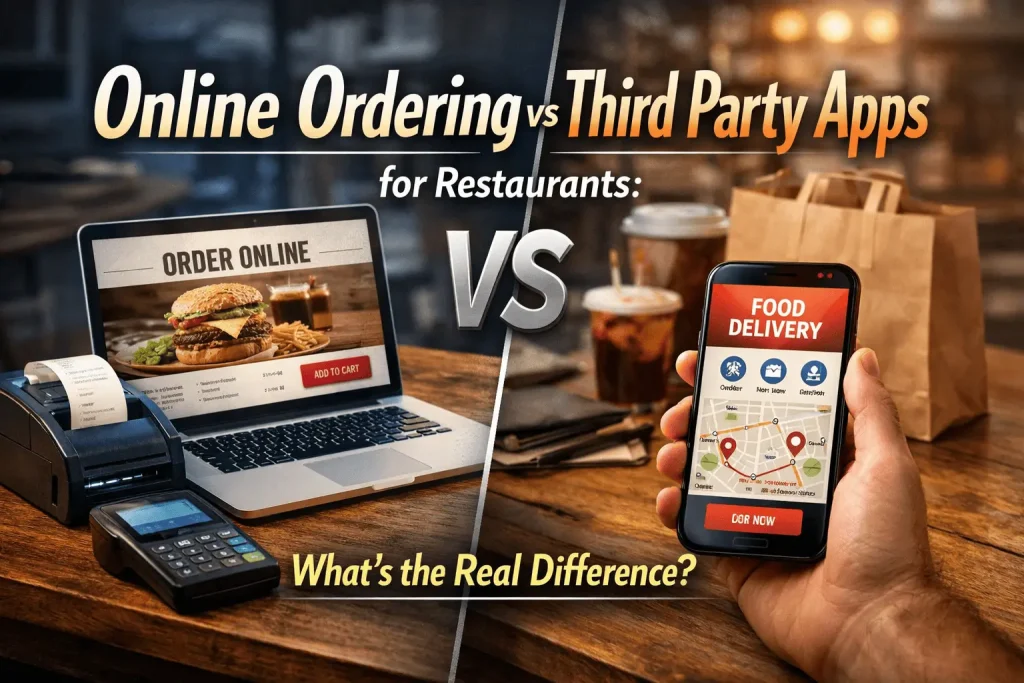
Nowadays, restaurants face a critical decision: Whether to rely on third-party delivery apps or invest in their own online ordering system. Here, the choice goes far beyond convenience. This is because it has the potential to influence profit margins, customer loyalty, along with the long-term growth of the business. So, understanding the real differences can help restaurants make strategic decisions instead of reactive ones.
What is an Online Ordering System for Restaurants?
An online ordering system for restaurants allows diners to place their orders straight through the restaurant’s website or even a dedicated restaurant ordering app. Each order actually goes straight to the restaurant, eliminating third-party commissions and giving full control over pricing, promotions, as well as the overall customer experience. Beyond immediate sales, it also provides valuable customer data that can be utilized for loyalty programs, numerous targeted offers, and repeat business, and turns every transaction into a long-term asset.
Key benefits include:
- Complete control over menu, pricing, as well as discounts.
- Ownership of customer data for personalized marketing
- Stronger brand recognition and customer retention.
What are Third-Party Food Delivery Apps?
Food delivery apps for restaurants work as a middleman and connect restaurants to a large pool of customers. While this can increase order volume quickly, the trade-offs are significant. Several restaurants pay commissions on every order, have limited control over how their menu or even brand is presented, and rarely get access to customer information. Here, visibility mostly depends on app algorithms, paid promotions, or even ratings, meaning success on the platform is partly out of the restaurant’s hands.
Key considerations include:
- Immediate access to a wide customer base.
- Commissions reduce profit per order.
- Limited ability in order to build direct customer relationships or loyalty.
So, understanding the difference between a restaurant ordering app and third-party food delivery apps is truly essential for long-term planning. Since apps can drive short-term sales, investing in a direct online ordering system gives restaurants control, higher margins, as well as a stronger foundation for sustainable growth.
How Online Ordering Works for Restaurants (Without Third-Party Apps)
A direct ordering system gives restaurants an edge to manage orders seamlessly without being dependent on third-party platforms. Unlike apps that actually work as intermediaries, these systems give restaurants complete control over how orders are received, processed, and fulfilled. Here’s how exactly it works:
Website Ordering System
Several restaurants integrate a dedicated ordering system straight into their website. Customers can browse the menu, customize their orders, and check out without getting jumped out of the site. This approach keeps the brand front and center and eliminates third-party fees.
QR-Based Ordering
QR-based ordering is really becoming increasingly popular, especially for dine-in and takeaway services. Customers just scan a QR code on the table or packaging, view the menu, and then place their orders instantly. Now, this system prevents manual errors, speeds up service, encouraged by highlighting special offers directly on the menu interface.
Mobile Ordering Apps
Restaurants can also create their own mobile application and provide customers with a convenient way to order from anywhere. And, these apps can include loyalty programs, push notifications for various promotions, and personalized recommendations in themselves, and help drive orders and stronger customer engagement.
Integration with Payment Gateways
Furthermore, direct ordering systems integrate seamlessly with payment gateways and enable safe and instant transactions. Restaurants can support numerous payment options like credit/debit cards, UPI, as well as digital wallets, and provide the customers with flexibility ensuring that all revenue precisely flows directly to the business.
Direct Customer Communication
When it comes to one of the biggest advantages of a direct system it’s the ability to communicate with customers without any barrier. Restaurants can send their order confirmations, delivery updates, along with promotional messages without even relying on a third-party platform. This direct interaction strengthens customer relationships and provides valuable data for marketing and loyalty programs.
How Third-Party Delivery Apps Work for Restaurants
Third-party food delivery platforms are widely used, but it’s really crucial to understand their structure, as it helps restaurants assess their real impact on profits and operations:
- Commission Structure: Commission Structure: Platforms charge a percentage on every order. And, these commission charges of delivery apps can smartly reduce restaurant profit margins, mostly forcing higher menu prices in order to cover cost.
- Delivery Model: Most of the applications manage delivery through their women couriers. While convenient, this limits control over delivery speed, packaging, and the overall customer experience.
- Visibility and Ranking: Restaurants compete for attention inside the app. Their rankings totally depend on paid promotions, ratings, and order volume, which can make their visibility inconsistent and even costly.
- Dependence on the Platform: In third-party apps, customer data and relationships are solely controlled by the platform, and this makes restaurants dependent on the app for traffic and repeat business.
- Why Restaurants Use Them: Despite drawbacks, apps give quick access to a wide range of audiences and generate orders rapidly, which is especially useful for new or even small restaurants.
Which Option Gives Better Control Over Customers?
When we compare online ordering vs third-party apps for restaurants, then profitability always comes down to more than just total orders. As we discussed earlier, third-party apps charge their commissions on every sale, and it can take a big chunk out of restaurant profit margins. Most of the restaurants don’t realize there are additional hidden fees for promotions, priority listings, or sometimes service charges.
Over time, these costs add up and reduce long-term profitability even if the order volume is high. On the other hand, a direct online ordering system eliminates commissions, gives you full control over pricing and promotions, and ensures that each order contributes to profit directly. Even if the volume is slightly lower, the margins are higher, predictable, and free from unexpected fees, and this makes it a far more suitable and financially advantageous option in the long run.
Conclusion
The decision between online ordering vs third-party apps for restaurants ultimately shapes a restaurant’s profitability, customer loyalty, along with long-term growth. And, third-party apps can truly bring immediate orders and exposure, but they reduce margins, limit control over branding, and keep restaurants dependent on the platform.
Whereas, direct online systems give full control over pricing, promotions, along with customer data, and turn each order into a valuable chance to build repeat business and sustainable profits.
Restaurants that primarily focus on both efficiency and long-term growth can benefit greatly from a well-designed online ordering system. In order to implement a solution that enhances revenue, customer engagement, and operational control, Mypcot Infotech offers customized online ordering solutions that deliver smart results.