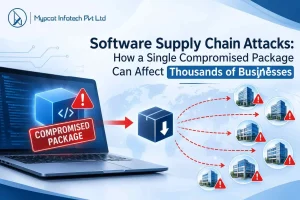
Actually, a single line of code can become a business-wide problem when its origin is compromised. Modern applications depend on hundreds of external components, along with developers mostly integrate them without examining every line of code individually. That reliance is practical, but it creates a risk that traditional security checks can easily overlook. Software supply chain attacks exploit this gap by targeting the components and processes used to build, update, and distribute software.
An attacker might publish a malicious software package, compromise a developer’s account or tamper with a trusted update mechanism. Once introduced into a development environment, the compromised component can affect multiple applications and expose the wider organisation to security risks.
Understanding how these attacks happened helps businesses look beyond their own source code and evaluate the security of every external component and service their software depends on.
Table of Contents
ToggleWhat Is Third-Party Data Breach Liability?
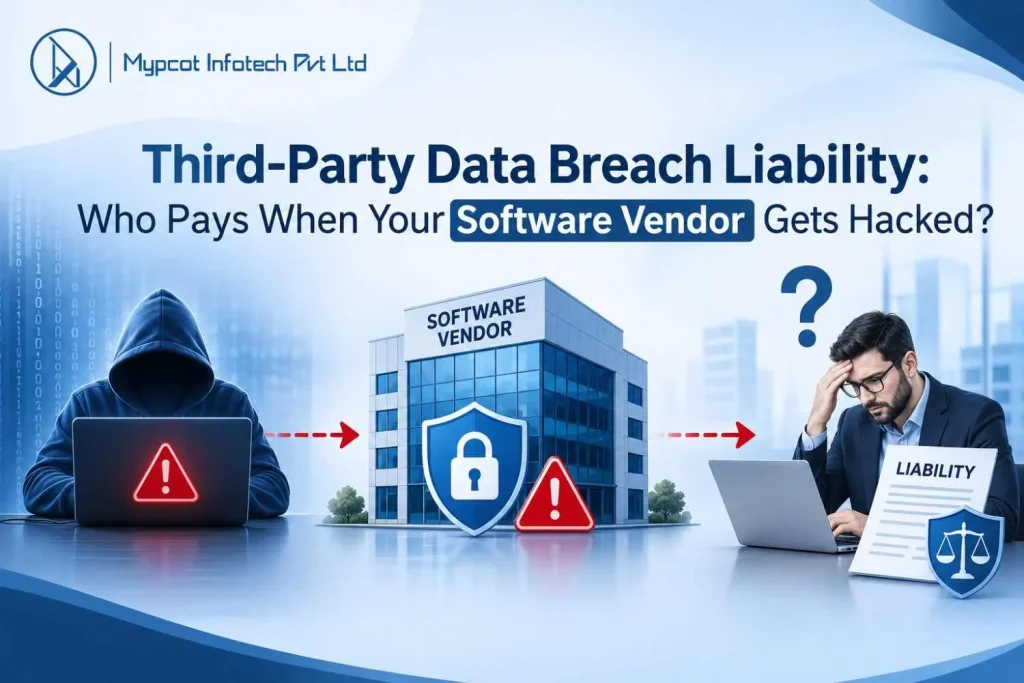
Third-party data breach liability refers to the potential legal and financial responsibility a business may face when an external service provider suffers a security breach involving its data. Businesses often share sensitive information with cloud service providers, CRM platforms, payment processors and other external IT partners to manage their daily operations.
For example, if attackers breach a retailer’s CRM provider and steal customer records, the retailer may face consequences even though its own servers remain secure.
Being breached by a third party can result in the exposure of:
- Customer data: Customers’ names, contact information, and sales records.
- Financial data: Payment information and payment history.
- Business information – Employee records, confidential documents and login details.
Contractual, security policies, and relevant data protection legislation are the factors that determine responsibility. A direct breach starts within a company’s systems, while a third-party breach begins with an external party. But companies could still be liable for their choices of vendors, data sharing, and tracking security risks.
Who Is Responsible When a Software Vendor Gets Hacked?
Responsibility does not automatically fall on the organisation whose systems were compromised. A business and its software vendor may have different obligations, and both can face consequences depending on their actions.
The Business That Collects Customer Data
This doesn’t mean that a company loses its duty of care over customer data when it outsources it. It must make reasonable efforts to make sure the external provider protects the information.
This includes:
- Choosing vendors who have proper security procedures.
- Knowing what types of data are being shared with customers.
- Defining appropriate data protection needs.
- Periodic review of vendor security.
- Reacting appropriately to the disclosure of information.
The Third-Party Software Provider
A vendor may face contractual or legal consequences if its security failures contribute to a breach. This could be weak access measures, lack of proper upkeep of infrastructure, or lack of adherence to agreed safeguards or reporting of breaches.
Can Both Parties Share Responsibility?
Yes. A vendor may not have applied a patch for an identified vulnerability; The client business may also have granted excessive access to customer data or failed to enforce appropriate access restrictions.
However, the organisation whose systems were initially compromised may not be solely responsible for the resulting damage. Liability depends on each party’s security practices, contractual obligations and role in the incident.
What Does India’s DPDP Act Say About Third-Party Data Breach Liability?
India’s Digital Personal Data Protection Act, 2023, distinguishes between two important roles:
- Data Fiduciary: The organisation that determines why and how personal data is processed.
- Data Processor: An organisation that processes personal data on behalf of a Data Fiduciary.
For example, a retailer using an external CRM platform may act as the Data Fiduciary, while the CRM provider acts as its Data Processor.
The Act does not allow a Data Fiduciary to treat outsourcing as a complete transfer of responsibility. It must ensure that processing carried out on its behalf follows applicable legal requirements, including appropriate security safeguards.
Businesses should pay particular attention to:
- Contractual arrangements: Define how the processor can use and protect personal data.
- Security safeguards: Ensure appropriate measures protect information against unauthorised access and breaches.
- Breach reporting: Understand applicable notification obligations under the Act and the DPDP Rules, 2025.
- Vendor oversight: Review how external processors handle and secure personal information.
A vendor may also face contractual or other legal consequences depending on its conduct. However, the exact obligations and notification timelines depend on the provisions in force and the circumstances of the incident.
Who Pays for the Damage After a Third-Party Data Breach?
The financial impact of a vendor breach can extend well beyond the cost of fixing compromised software. Businesses may need to manage several expenses:
- Investigation and recovery: Forensic analysis, identifying exposed records and restoring affected systems.
- Customer communication: Notifying affected individuals, handling complaints and providing support.
- Legal and regulatory expenses: Legal advice, regulatory responses, disputes and applicable penalties.
- Business interruption: Downtime, cancelled contracts, lost customers and reputational damage.
The vendor, client business or their insurers may initially cover different expenses. The final allocation depends on contractual terms, applicable law, insurance coverage and the facts of the incident.
How Vendor Contracts Determine Data Breach Liability
A software agreement should explain how customer information is handled and what happens if a security incident occurs. Important provisions include:
- Data Processing Agreement (DPA): Defines what information the vendor can access, how it can use it and what safeguards it must maintain.
- Breach notification: Establishes reporting timelines, required details and cooperation during investigations.
- Indemnity and liability limits: Clarifies which losses a party may be required to cover and whether recovery is subject to contractual limits.
- Cyber insurance: Specifies relevant insurance requirements and coverage expectations.
- Data retention and deletion: Defines how long information is stored and how it must be deleted when no longer required.
A contract can allocate responsibilities between the parties, but it cannot automatically remove statutory obligations.
Real-World Third-Party Data Breaches: What Businesses Can Learn
MOVEit Transfer Breach (2023)
In 2023, attackers exploited a zero-day vulnerability in Progress Software’s MOVEit Transfer platform, a tool used by organisations to transfer sensitive files. The attack affected numerous organisations that relied on the software, exposing data held across different environments.
Business lesson: A vulnerability in one widely used platform can create security risks for many unrelated organisations.
Blackbaud Data Breach (2020)
Blackbaud, a provider of cloud software used by nonprofit organisations and educational institutions, suffered a ransomware attack in 2020. The incident exposed data belonging to several customers. The US Federal Trade Commission later took action over the company’s security practices.
Business lesson: Software vendors can face direct consequences for security failures, while their customers must also manage the impact on their own users and operations.
How Businesses Can Reduce Third-Party Data Breach Liability
Preventing every vendor breach is impossible, but businesses can reduce their exposure through consistent oversight.
- Verify vendors prior to engagement: Conduct security assessments, check data policies, and review past problems.
- Reduce sharing of information: Share only information needed to perform services.
- Improve access restrictions: Apply role-based access and multi-factor authentication.
- Regularly review security: Reassess vendors if there is a change in risk profile, infrastructure, or services.
- Research subcontractors: Figure out if providers use other cloud platforms or outsiders.
- Develop an incident response plan: Define roles for reporting, investigating and communicating in the event of a breach.
Vendor risk management should be an ongoing process, not a one-time assessment conducted before signing a contract.
What Should a Business Do When Its Software Vendor Reports a Breach?
A swift and organised response can reduce additional exposure and will ease business obligations.
- Acknowledge the incident: Clarify the services and systems that have been impacted.
- Determine if customer, employee or confidential business data was exposed.
- Manage the risk: Audit associated accounts, credentials, integrations and access rights.
- Coordinate with a vendor: Ask for updates on investigations and proof.
- Evaluate legal obligations: Meet with legal and privacy practitioners to discuss the relevant reporting requirements.
- Communicate accurately: Provide affected stakeholders with verified information, as necessary.
- Re-investigate the relationship: Determine if there are any other protections needed or if another provider is required.
Businesses should assess their potential exposure immediately rather than waiting for the vendor to complete its internal investigation.
Building More Secure Software Partnerships With Mypcot Infotech
Security is a must during the software development process for reliable software partnerships. That means secure application architecture, controlled API Integrations, data protection, testing prior to deployment, the right access permissions, and more.
Mypcot Infotech, one of the best AI development companies, specializes in creating reliable, scalable, and maintainable software solutions. Incorporating security in application development and integration provides businesses with a more robust base for their technology and can help them deal with any emerging security issues better.
Conclusion
Reliable software partnerships begin with security being considered at every stage of the development process, from architecture and integration to testing and deployment.
Before sharing sensitive data with another business, it is critical for that one to be aware of where the information is going, who has access to it, and the security needs of both companies. The right vendor relationship can help limit exposure and minimize its impact if it is breached.