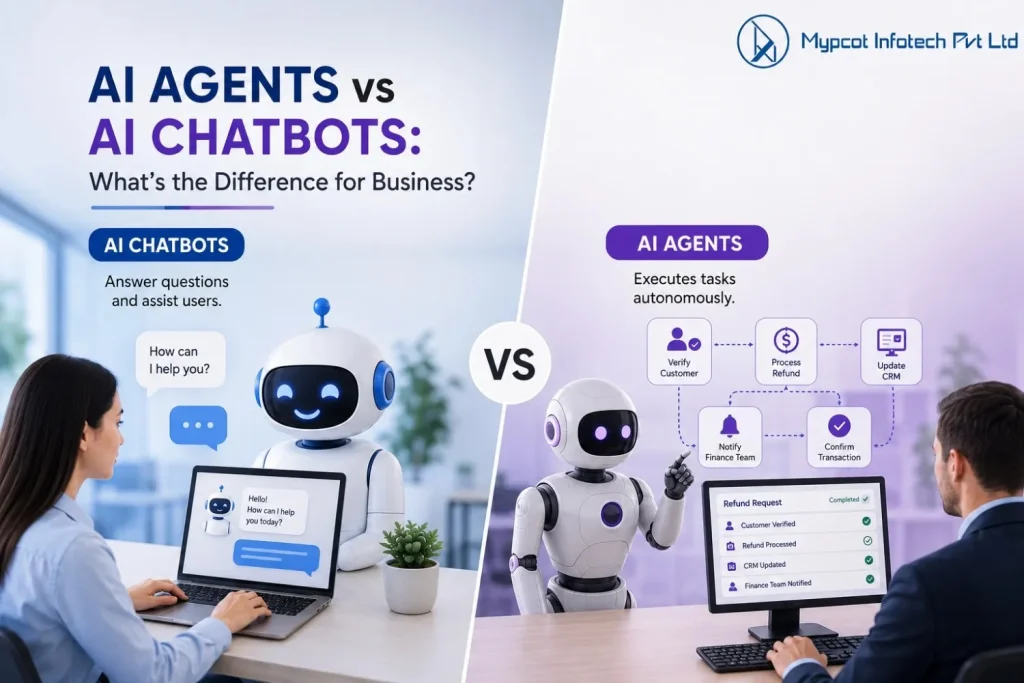
A customer asked to cancel an order and then requested a refund. Here, an AI chatbot can explain your return policy and share the necessary steps. On the other hand, an AI agent can verify the customer’s identity, check the eligibility for a refund, initiate the request, update your CRM, notify the finance team, and then confirm the transaction, that’s all without human intervention.
Actually, the difference isn’t just in how they respond. It’s in what exactly they can accomplish. For businesses, that difference can mean faster resolutions, lower operational costs, improved customer satisfaction, along with greater productivity.
This is why understanding AI agents vs AI chatbots has truly become a priority for businesses rather than just a technology discussion. While both solutions help businesses automate customer interactions, they are smartly designed for different levels of intelligence, automation, and decision-making. So, choosing the right one can directly impact operational efficiency, scalability, and ROI. In this blog, we’ll explore their key differences, real-world business applications, advantages, limitations, and how to consider which solution is suitable for your organization’s long-term growth.
Table of Contents
ToggleWhat Are AI Chatbots?
AI chatbots are intelligent software applications. They interacts with users through text or voice using Conversational AI along with Natural Language Processing (NLP). Unlike traditional rule-based chatbots that depend on some predefined scripts, modern AI chatbots have the potential to understand user intent, interpret natural language, and then deliver contextually relevant responses. Ultimately, businesses can automate their routine conversations and provide faster, even more consistent, and personalized customer interaction across websites, mobile apps, messaging platforms, along with social media channels.
What makes AI chatbots a valuable business tool is their ability to:
- Manage thousands of customer conversations simultaneously without even compromising response time.
- Deliver consistent, on-brand interactions across multiple communication channels.
- Reduces the workload of support teams by automating repetitive custom queries.
- Improve overall satisfaction by providing instant and round-the-clock support and enabling efficient customer support automation.
What Are AI Agents?
AI agents are intelligent AI systems capable of comprehending objectives, thinking through intricate tasks, and acting with those objectives with minimal human intervention. They are driven by powerful Large Language Models (LLMs), advanced reasoning, and contextual memory, which enable them to analyze information, make decisions, and execute multi-step processes across interconnected business systems. Unlike AI chatbots, AI agents are designed to achieve specific goals by planning, reasoning, and executing end-to-end workflows across multiple systems.
AI agents can be beneficial for businesses in several ways, such as:
- Independent decision-making processes, which enable them to assess situations, formulate actions, and carry out multiple-step tasks with only a limited human assistance.
- Contextual memory and reasoning enable them to remember the information they need, grasp user intent, and provide more relevant, accurate answers.
- The integration with other enterprise systems like CRMs, ERPs, APIs, databases, and others enables workflow automation and helps business processes run smoothly.
- More powerful Enterprise AI features to enable efficiency, decrease manual workloads, accelerate decision-making, and drive business development at scale.
AI Agents vs AI Chatbots: Key Differences
| Feature | AI Chatbots | AI Agents |
| Purpose | Answer questions and assist users. | Executes tasks autonomously |
| Decision-Making | Follows predefined rules. | Analyzes, reasons, and makes decisions. |
| Memory | Limited conversation context. | Remembers context across interactions. |
| Autonomy | Requires user interaction | Complete workflows with minimal human intervention. |
| Tasks | Best for simple, repetitive tasks. | Handles complex, multi-step workflows. |
| Integrations | Connects with basic business tools. | Works with CRMs, APIs, databases, and enterprise systems. |
| Best For | Customer engagement and routine conversations. | Automate complex operations, improve productivity |
| Cost | Lower cost and quicker to deploy. | Higher investment with stronger long-term value. |
How AI Chatbots Work
AI chatbots use Natural Language Processing (NLP) and Conversational AI to understand user queries, identify intent, and generate relevant responses. These “real-time” processes combine AI models, pre-defined rules, and interconnected knowledge sources to provide fast and accurate answers to requests.
The process is as follows:
- Listens to the user and responds to the query in text or voice.
- Understands the user’s intentions by analyzing them with NLP.
- Looks for the best match information in its knowledge base or predefined workflows.
- Generates an appropriate response and continues the conversation if needed.
- Redirects the ticket to a Human Agent if it is not certain to solve the ticket.
How AI Agents Work?
AI agents are designed to understand goals, make decisions, and take actions, whereas AI chatbots are designed to answer questions. They aren’t only designed for information dissemination; they can automate workflows, with the help of Large Language Models (LLMs), contextual reasoning, and system interconnections within the business. This makes them a powerful solution for workflow automation and complex business operations.
Typical operations of an AI agent:
- Understands what the user wants and their purpose/desire.
- Evaluates the request using context, business rules, and available information.
- Creates an action plan and makes decisions on how to take the best action.
- Accesses other systems such as CRM, databases, APIs, or ERPs to retrieve and/or update data.
- Performs tasks required, such as taking care of an order, scheduling an appointment, or producing a report.
- Learns from the outcome of completed tasks and uses feedback to improve future decisions where applicable.
AI Agents vs AI Chatbots for Business
Both AI chatbots and AI agents help businesses automate operations, but their impact varies across industries. Chatbots work best for repetitive tasks, like customer service, answering FAQs, scheduling appointments, and answering simple questions. AI agents, on the other hand, have the ability to boost businesses’ value by automating complex workflows in customer service, sales, HR, healthcare, retail, travel, finance, and manufacturing. They can analyse the data, make decisions, integrate with enterprise systems, and perform multi-step tasks, which will allow businesses to enhance productivity and cost reduction as well as create a more personalised customer experience.
When Should Businesses Choose AI Chatbots?
For businesses with simple, repetitive customer interactions, AI chatbots are often the better choice. These are affordable, easily deployable options, suited to faster response time, and better suited to handle the workload of customer support teams.
Use AI chatbots when your business requires:
- Get answers to common queries (FAQs) instantly.
- Make appointments, bookings or consultations.
- Capture and qualify visitors of your website.
- Track orders and give updates on the deliveries.
- Respond to basic customer support and standard questions 24/7.
When Should Businesses Choose AI Agents?
For businesses seeking to streamline complex processes, enhance decision-making, and boost efficiency, AI agents are the perfect solution. They can understand context, connect with company systems, and perform multi-step tasks with very little human interaction, which makes them a worthwhile investment for long-term company development. AI chatbots, on the other hand, can not perform multi-step tasks, integrate with company systems, or comprehend context without needing a lot of human intervention.
Select AI agents when your business requires to:
- Automate long and complicated workflows between teams and departments.
- Automatically manage CRM updates, customer data and follow-up actions.
- Support sales teams with lead prioritization, customizing outreach, and opportunity tracking.
- Handle HR, IT and internal business requests for support.
- Simplify the internal processes and integrate multiple business applications.
- Analyze data and provide intelligent recommendations for action.
Which One Should You Use?
Operational needs and desired automation levels dictate whether to use AI chatbots or AI agents. AI chatbots can be advantageous for businesses seeking to automate customer interactions, manage frequently asked questions, and provide prompt support. For more sophisticated automation needs, however, organizations looking to streamline workflows, boost productivity, and make informed business decisions may want to consider AI agents for these more complex automation tasks.
Conclusion
AI agents and AI chatbots aren’t competing technologies, they solve different business problems. It’s all about choosing the right solution for your business goals, complexity, and customer expectations.
AI chatbots are capable of providing quick and consistent customer interactions, whereas AI agents take it a step further by automating intricate processes, making intelligent decisions, and interacting smoothly with enterprise systems. As companies keep integrating AI-powered transformation, picking the best solution can enhance effectiveness, cut expenses, and foster better customer experiences.
Whether you are interested in creating AI solutions that fit your business needs, Mypcot Infotech can help you design, develop, and deploy intelligent AI chatbots and AI agents that can drive measurable growth in your business.