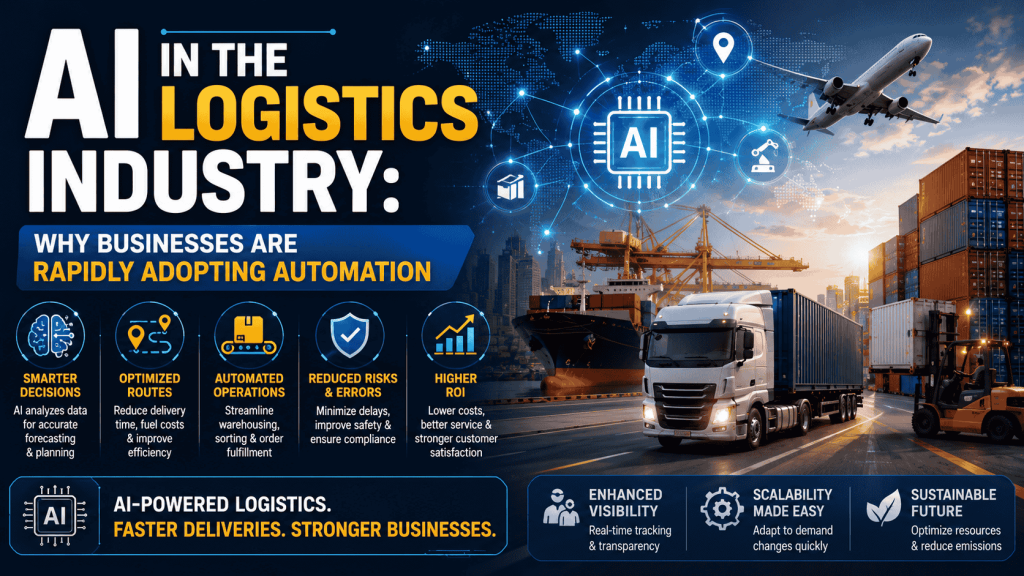
The logistics industry actually never had a shortage of data. Here, every shipment, delivery route, inventory movement, along with customer orders, generates valuable information. If we talk about the real challenge, it has always been turning that data into better decisions. And that’s where AI in the logistics industry is making a difference. Rather than reacting to delays, disruptions, or even changing demand, businesses can now anticipate them and respond proactively.
From starter warehouse operations and route optimization to predictive analytics and supply chain visibility, AI is supporting logistics companies with higher precision and efficiency.
In this blog, we’ll explore how exactly AI transforms logistics operations, the real value benefits it brings, the challenges businesses should consider, as well as what the future holds for this growing industry.
Table of Contents
ToggleHow AI in the Logistics Industry Is Transforming Supply Chain Operations?
From planning inventory to managing deliveries, AI in the logistics industry is supporting businesses to run smarter and even more efficient supply chains. Here’s how AI is improving key areas of supply chain operations:
- Intelligent Demand Forecasting
Requirements can be changed quickly due to market trends, seasonal shifts, or sometimes customer behavior. Here, AI helps you forecast demand more accurately than ever, reduce the possibility of stock shortages or even excess inventory and ultimately improve planning.
- Inventory Optimization
Maintaining the precise inventory balance is really a constant challenge. When we integrate AI, we can identify demand patterns and stock imbalances across various locations, and this helps us improve utilization and reduce unnecessary utilization and storage costs.
- Automated Scheduling
Coordinating deliveries, warehouse activities, and transportation resources truly needs continuous planning. When businesses implement logistics automation, AI can adjust schedules based on real-time conditions and help teams operate even more efficiently and minimize delays.
- Real-Time Shipment Tracking
AI improves supply chain visibility. It analyzes shipment data alongside factors like traffic and delivery performance. Now, this allows businesses to detect potential disruptions early and respond before they even affect customers.
- Predictive Maintenance
Unexpected equipment or even vehicle failures can disrupt operations and increase costs. AI monitors performance data in order to detect potential issues earlier and help businesses reduce downtime and improve reliability.
- Building Smarter Operations
Actually, the true value of AI in the logistics industry lies in helping businesses make better decisions across the supply chain. AI helps improve forecasting, inventory management, tracking, along with maintenance. Furthermore, it’s also helping logistics companies build even more efficient, agile, and resilient operations.
Major Applications of AI in Modern Logistics Operations
AI-Based Route Optimization
AI has the potential to analyze traffic, weather, along with delivery schedules in order to identify efficient routes and reduce fuel costs and delivery delays.
Predictive Analytics in Logistics
By analyzing historical and real-time data, AI helps businesses predict demand and identify potential supply chain disruptions.
Fleet Management Automation
AI tracks vehicle performance, fuel consumption, and maintenance requirements, and ultimately improves fleet efficiency and reduces operational costs.
AI-Powered Customer Support
AI chatbots give instant shipment updates and resolve routine queries, and improve customer experience and response times.
Traditional Logistics vs AI-Driven Logistics
While traditional logistics focuses on reacting to issues as they arise, AI-driven logistics helps businesses predict, prevent, and respond to challenges more effectively.
| Traditional Logistics | AI-Driven Logistics |
| Manual planning | Predictive planning |
| Delayed tracking and limited visibility | Real-time visibility across operations |
| Reactive maintenance | Predictive maintenance |
| Fixed delivery routes | Dynamic route optimization |
| Higher risk of manual errors | Greater accuracy through automation |
| Reactive decision-making | Data-driven, proactive decisions |
| Basic inventory planning | AI-powered demand forecasting |
Key Benefits of AI-Powered Logistics Automation
Beyond improving day-to-day operations, AI in the logistics industry also helps you reduce costs, increase efficiency, and deliver better outcomes across the supply chain. Here are some of its key benefits:
- Faster Deliveries: As we discussed earlier, AI helps optimize routes, prioritize shipments accordingly, and detect potential delays before they even make a negative impact on delivery schedules. This feature allows businesses to shorten their transit times and improve on-time delivery rates, especially during peak demand periods.
- Lower Fuel Costs: Fuel always remains one of the largest operational expenses in logistics. AI-based route optimization reduces unnecessary mileage, reduces idle time, and ultimately helps deliver more efficient routes, and this results in significant fuel savings over time.
- Reduced Human Errors: As we know, manual processes often result in mistakes in inventory management, scheduling, order processing, and shipment tracking. Furthermore, automation reduces repetitive tasks and improves accuracy, and helps businesses prevent costly errors and operational disruptions.
- Improved Customer Satisfaction: Modern customers expect faster deliveries and real-time updates. AI enhances supply chain visibility and allows organizations to provide more accurate delivery data, respond quickly to issues, and create a more reliable customer experience.
- Better Warehouse Efficiency: AI-powered systems help businesses optimize inventory placement, automate routine warehouse tasks, and enhance order processing workflows. This feature allows warehouses to handle higher order volumes and maintain speed and accuracy.
- Scalable Operations: When businesses expand, managing order volumes and a more complex supply chain becomes highly challenging. With artificial intelligence, it’s easy. It enables operations to scale efficiently without even a proportional increase in manual effort, and enables companies to support growth and maintain operational control.
Turning Efficiency Into Competitive Advantage
The real value of logistics automation lies in its business impact. Faster deliveries, lower operating costs, improved accuracy, and better customer experience promote companies’ strong supply chains and then companies gain a competitive edge in an increasingly demanding market.
Challenges Businesses Face While Implementing AI in Logistics
While AI in the logistics industry provides significant advantages, adoption isn’t always simple. Businesses mostly face a few common challenges during the implementation process. These are the common challenges:
High Setup Costs
AI solutions need investment in technology, infrastructure, along with system upgrades, and this can make the initial rollout costly for some businesses.
Legacy Software Integration
Many logistics companies still operate on older systems. And, with those older systems, it can be difficult to integrate with modern AI tools.
Employee Training Needs
Teams need proper training in order to use AI effectively and adapt to new workflows and processes.
Data Privacy & Accuracy
AI depends on large volumes of reliable data. Poor data quality or sometimes security concerns can affect performance and decision-making.
Resistance to Change
Employees and stakeholders can be hesitant to adopt new technologies, especially when existing processes have been in place for several years.
How Businesses Can Overcome These Challenges?
So, how can businesses successfully adopt AI in the logistics industry without disrupting their operations? Here, the key is to start small and scale strategically. Rather than overhauling the complete supply chain at once, companies can begin with high-impact areas like route optimization, inventory management, etc.
Also, equally important is investing in employee training, maintaining accurate data, and selecting AI solutions that integrate smoothly with existing systems. With a clear roadmap and realistic goals, businesses can overcome implementation challenges and unlock long-term operational benefits.
Future Trends of AI in the Logistics Industry
When it comes to future trends of AI in the logistics industry, the next phase will truly be less about automating individual tasks and more about creating connected, intelligent supply chains. AI technologies become even more advanced, businesses will gain numerous new ways to improve efficiency, strengthen resilience, and make faster strategic decisions.
Conclusion
The true impact of AI in the logistics industry goes beyond just automation. It allows you to make faster, smarter decisions, improve your overall supply chain visibility, optimize resources, and respond more effectively to dynamic market demands. As logistics operations become increasingly complex, companies that leverage AI strategically will be better equipped to improve efficiency, reduce costs, and build even more resilient supply chains.
So, are you also looking to bring AI into your logistics operations? Mypcot Infotech develops custom AI applications, intelligent automation solutions, and logistics software designed to streamline workflows, solve operational challenges, and support long-term business growth.