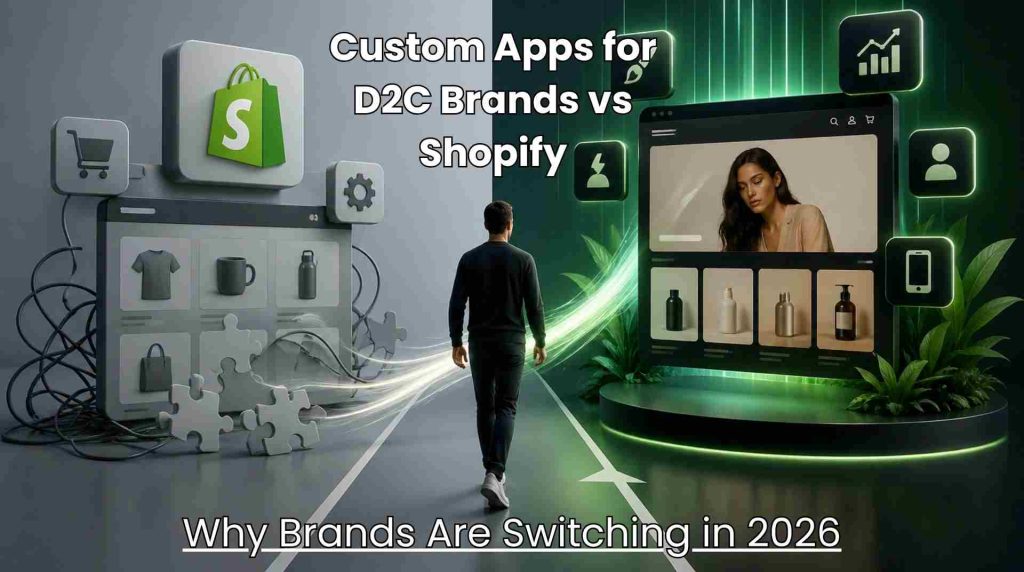
At some point, most of the D2C brands realise that the platform they started was not designed to support their evolving operational complexity as they scale. Shopify does its job well in the very beginning. The platform helps you launch fast, test ideas, and start selling without getting stuck in a technical setup. However, when your preferences grow, you start noticing the gaps. You just depend on multiple third-party apps, the system becomes harder to optimize, and small changes start taking even more effort than expected.
Custom apps empower D2C brands with complete control over user experience, enabling higher engagement and better conversions than standard eCommerce platforms.
That’s usually when custom apps for D2C brands start entering the picture. Rather than working around platform limits, you start building around how your business actually runs. It gives you control over the experience, better room for optimization, along with the ability to shape every step of the customer journey in a more intentional way.
This blog breaks down why that shift is happening and how to know if it’s the right move for your brand.
Table of Contents
ToggleWhat Are Custom Apps for D2C Brands and How Are They Different from Shopify?
Custom Apps for D2C brands are designed specifically for how exactly a brand sells and makes interactions with its customers. Rather than utilising a fixed structure, everything is built around your workflows, user journey, along with growth goals.
Shopify is a ready-made e-commerce platform. You can quickly launch, easily manage, and work well whenever you’re starting out. Shopify comes with predefined systems, and advanced customizations, integrations, and performance optimizations depend heavily on third-party apps so flexibility is very limited here.
That’s exactly the core difference.
With Shopify, you operate within a platform. On the other hand, with custom solutions, you build and control the whole experience. No reliance on multiple apps, significantly fewer structural limits.
In simple terms, it’s actually an e-commerce platform vs a custom solution, convenience vs control.
Why Custom Apps for D2C Brands Are Gaining Popularity in 2026?
Actually, the demand for custom apps for D2C brands is growing as brands now need more than just functional stores. On top of that, they also need control over experience, performance, along with customer relationships in order to scale effectively. Here’s more why its popularity is increasing:
1. Mobile-First Shift
Customers now mostly start their journey on mobile, from discovery to checkout. Here, even small delays or fractions can result in drop-offs. That’s exactly why D2C mobile app development is becoming essential, and helps brands deliver faster, smoother experiences that directly improve conversion.
2. Focus on Retention
With rising acquisition costs, brands now like to prioritise repeat purchase and lifetime value. It actually depends on how well you engage and personalise the experience. Custom applications make it easier to build journeys that keep your customers coming back.
3. Need for Ownership
Being completely dependent on third-party platforms limits your control over data and communication. Numerous brands are shifting towards channels they fully own. Custom apps for D2C brands give an advantage in terms of engagement and better control over customer relationships.
4. Platform Limitations
Shopify works well early on, but as brands grow, app dependencies and limited flexibility can slow things down. This is where the shift from an ecommerce platform vs custom solution becomes important for long-term scalability, often supported by an experienced app development company.
Shopify vs Custom Apps for D2C Brands: A Practical Comparison
| Factor | Shopify | Custom Apps for D2C Brands |
| Setup Time | Quick to launch, can go live in days | Takes time, requires planning and development |
| Cost (Short vs Long Term) | Lower upfront cost, but ongoing app and transaction fees add up | Higher upfront investment, but more cost-efficient at scale |
| Customization | Limited to themes and plugins | Fully customizable based on business needs |
| Performance | Can slow down with multiple apps | Optimized for speed and smoother user experience |
| Scalability | Works efficiently for standard use cases, but becomes restrictive for complex workflows | Built to scale without structural limits |
| Data Ownership | Partial control, platform-dependent | Full control over customer data and insights |
| Conversion Optimization | Limited flexibility in checkout and flows | Complete control to optimize every step of the journey |
When Should You Choose Custom Apps for D2C Brands?
When it comes to choosing apps for D2C brands is not all about preference. It’s about timing. The need generally shows up through specific situations as your brand grows. Here’s a detailed view on various situations:
1. You’re Just Starting Out
If you’re currently validating your product or even figuring out your market, then Shopify is the perfect choice. You need speed, not complexity. At this phase, investing in custom development won’t add that much value and can slow you down.
2. You’re Growing but Feeling Limitations
Once you start receiving orders consistently and start scaling your ads, small gaps start to slow you down. It also can happen that maybe your checkout isn’t converting as well, or you’re relying on too many apps. That’s exactly where a hybrid approach works, introducing custom apps for D2C brands in areas like mobile experiences or even personalisation while still using Shopify as the base.
3. Your Revenue Depends on Repeat Customers
If anyone’s brand relies on repeat purchases such as skincare, supplements, or even FMCG, then experience truly matters more than ever. You need better retention flows, faster journeys, along with personalization. Custom apps help you control all of this without any limitations.
4. You Run a Subscription or Community-Led Brand
Complex Subscription models and community-based brands require flexibility that standard platforms struggle with. Managing several plans, engagement, along with user journeys becomes easier with a custom setup designed around your business logic.
5. You’re Scaling and Need Full Control
At scale, performance, data along with experience directly impact revenue. If you’re also constantly working around limits of platform, then it’s a clear signal to move toward custom solutions and build such a system that can support growth rather than restricting it.
Cost Breakdown: Shopify vs Custom Apps for D2C Brands
Whenever comparing with custom apps for D2C brands, the mistake several people make is looking only at the upfront cost. Here, the real difference shows up over time. So, it’s clear that it’s not about what you spend. It’s about what you exactly get back in control, performance, as well as gr:
Shopify: Lower Entry Cost, Higher Ongoing Spend
Shopify feels affordable in the starting, and that’s why most brands choose it.
- Monthly fees are predictable, but they can rise when you scale to higher plans.
- App costs add up instantly, especially for some features like subscriptions, upsells, reviews, and analytics.
- Transaction fees (if not using Shopify Payments) eat into margins over time
Individually, these costs don’t feel heavy. But when your store grows and depends on more apps, then your monthly spend silently becomes significant. You’re essentially paying for convenience and speed.
Custom Apps: Higher Investment, Stronger Long-Term Value
With custom apps, the cost structure is fundamentally different.
- Development cost is the primary upfront investment, as everything is built from scratch.
- Maintenance involves updates, hosting, along with technical support.
- Reduced app dependency on multiple third-party apps, which reduces recurring costs over time
While the initial investment is higher, the system is developed significantly for your business. You’re not actually for multiple third-party tools or even working around limitations.
The Real Difference: Cheap vs Valuable
Shopify is affordable in the sense that it lessens the barrier to entry. You can just start instantly without any major investment.
Custom applications are valuable as they provide you with control over performance, user experience, as well as conversions. At scale, even small improvements in speed or retention can generate significantly more revenue, mostly outweighing the initial costs.
How Custom Apps Improve Conversions and Retention for D2C Brands?
The real strength of custom applications lies in how these apps directly improve conversion and retention. Here’s how:
1. Faster Load Times
Speed really has a direct influence on conversions. Custom built apps remove unnecessary dependencies and make the whole experience faster and smoother. Furthermore, it also reduces drop-offs and supports better e-commerce conversion optimization, especially on mobile.
2. Personalized Experience
Custom applications enable you to customize product recommendations, offers and journeys according to the behaviour of users. And, this makes the experience even more relevant, which naturally improves engagement and conversion rates.
3. Push Notifications
These apps provide you with a direct channel to bring users back. From offers to reminders, push notifications help attract repeat visits without even being dependent solely on paid ads.
4. Better Checkout
When it comes to checkout, it’s a major drop-off point. With custom apps, you can easily simplify the flow, reduce friction, while creating a faster and smoother process that improves conversion.
5. Loyalty and Retention
Custom applications make it easier to build loyalty programs and personalized rewards into the journey. Now, this keeps your customers engaged and increases repeat purchases over time.
Conclusion
Custom applications are shaping how exactly modern brands scale, not just by selling more, but by providing a better experience at every step. When custom expectations rise, then being dependent solely on standard platforms can limit growth. The real advantage actually comes from owning your tech, your data, and your journey. So, if you’re also planning the next stage of growth, then Mypcot Infotech can help you build a custom solution that truly supports it.