In large-scale farming, success rarely comes from guesswork. Actually, it totally depends on timely decisions, accurate data, along with the ability to manage operations without even missing minor but important details. When you’re managing large fields, different crops, irrigation planning, and labour management at the same time, even a small delay can have a negative impact on the final results. It’s exactly why the demand for the right smart-featured app is growing as we move ahead in 2026.
For farming companies and commercial farmers, a smart farming app is no longer just a helpful tool. Over and above that, it’s something special that has become a practical way in order to improve productivity, control costs, and manage operations even more efficiently.
In this blog, we’ll explore the smart farming app features that truly matter for commercial farming, numerous advanced features shaping modern agriculture in 2026, along with the practical elements every agriculture app should include to be competitive and deliver real value.
What Are Smart Farming App Features and Why They Matter in 2026?
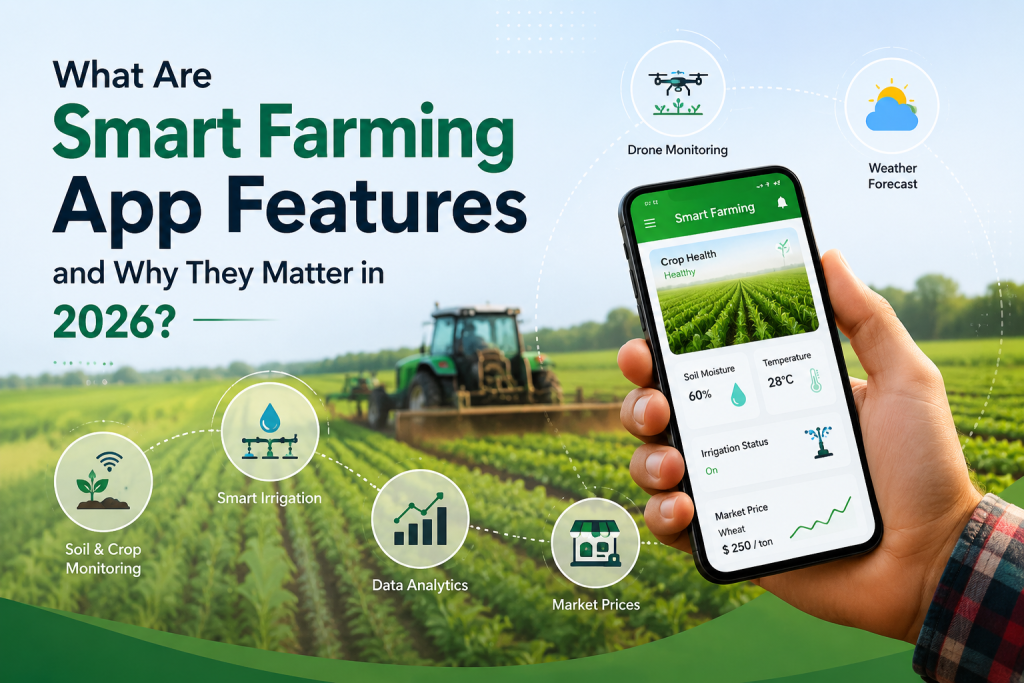
Smart farming app features are the practical tools inside an agriculture mobile application that really help farmers and farming companies smartly manage their operations through real-time data. Rather than being dependent on just manual tracking, these features allow users to monitor their crop health, track the performance of the field, manage irrigation, and make faster decisions with smart agriculture apps, digital farming tools, and modern agriculture app development solutions.
In 2026, these features will matter even more as large-scale farming truly needs better control and more accurate data. The right app has the potential to improve productivity and reduce avoidable losses directly.
Some features that are becoming truly valuable include:
- Live crop health tracking through satellite or sensor-based data
- Field-wise performance reports for smarter planning
- Smart irrigation notifications according to soil and weather conditions.
- Real-time tracking of farm activities across multiple fields.
- Market price insights in order to help farmers sell at the right time.
Top Smart Farming App Features That Are Changing Modern Agriculture
Here are the smart farming app features that are truly improving modern agriculture. These features can help large farmers and farming companies to manage operations efficiently, reduce server losses and improve overall productivity:
| Smart Farming App Feature | Benefits for Agriculture Businesses |
|---|---|
| Real-Time Crop Monitoring | Helps track crop health and improve productivity |
| Smart Irrigation Management | Reduces water wastage and improves efficiency |
| Weather Forecast Integration | Supports better farming and harvesting decisions |
| AI-Based Disease Detection | Detects crop issues early and minimizes losses |
| GPS Field Tracking | Improves farm monitoring and field management |
| Data Analytics Dashboard | Provides insights for smarter decision-making |
Real-Time Weather Forecast and Climate Alerts
Modern smart farming apps don’t just depend only on generic weather reports. But they use GPS-based location tracking, satellite weather data, along with integration of local weather stations. This feature allows the app to share accurate rainfall predictions, temperature changes, humidity levels, as well as extreme weather alerts. Now, farmers can plan their irrigations, pesticide spraying, and harvesting based on real-time conditions rather than assumptions.
AI-Based Crop Monitoring and Disease Detection
This is the feature that works by analysing crop images taken through a mobile camera or sometimes a drone. The application then compares these images with stored AI models in order to identify early signals of disease, pest attacks, or even nutrient deficiencies. Some of the apps also use satellite imagery just to track crop growth across large fields. And, this helps farmers take action before the problem spreads and affects the overall yield.
Soil Health Tracking and Smart Data Insights
Smart farming apps track soil health through IoT-based soil sensors that’s placed in the field. Now, these sensors measure moisture, temperature, and nutrient levels like nitrogen, phosphorus, and potassium as well. This data is sent straight to the app, where it’s actually converted into simple insights. This helps farmers comprehend when fertiliser is needed and how much is actually needed, instead of applying it blindly.
Farm Management Dashboard for Better Productivity
A farmer management dashboard actually functions just like a central control system. It perfectly collects data from crop monitoring tools, weather updates, soil sensors, and field records. Farmers are able to see field-wise performance, crop growth progress, irrigation schedules, and labour activities in just one place. And, this makes it totally easier to manage multiple fields without even confusion and helps improve planning.
IoT Integration for Smart Agriculture
IoT integration connects the mobile app with smart devices that are installed in the field, like soil moisture sensors, automated irrigation controllers, and weather stations. These devices regularly send data to the app in real time through IoT in agriculture technology. Rather than manually checking conditions, farmers receive live updates and alerts straight on their phones, which improves accuracy and saves time in modern smart farming applications.
Smart Irrigation Control System
This feature works by combining data for solid moisture sensors, weather forecasts, and crop growth stages. The application suggests automatically when irrigation is actually needed and how much water needs to be used. In advanced systems, the application can control automated irrigation systems remotely. This feature reduces water wastage and ensures crops receive the right amount of water at the right time.
Market Price Tracking for Farmers
Market price tracking features gather data from several agricultural markets and update prices in real time inside the application. Here, farmers are able to compare prices across different locations and decide when and exactly where to sell their crops. For large farming companies, this helps in better planning and improves profitability by avoiding poor pricing decisions.
GPS-Based Field Monitoring
GPS-based monitoring helps the app monitor the exact location of the field and crop areas through map-based technology. Farmers can mark different fields, track activities in each area, while tracking equipment or labour movement if really needed. This is especially useful for large farms where manual tracking of field activities becomes difficult and time-consuming.
Advanced Smart Farming App Features That Will Dominate in 2026
The next phase of agriculture will be driven by advanced smart farming app features that primarily focus on automation, AI, along with faster decision-making. Large farming companies and commercial farmers can avail the benefits of these features:
AI-Powered Farming Recommendations
It uses data from soil sensors, weather reports, and the performance of the crop in order to share real-time suggestions. Furthermore, it helps to decide the right time for irrigation, fertiliser use, and pest control.
Drone Integration in Agriculture Apps
Drone integration allows the app to monitor large fields using aerial images. It helps detect crop damage, unhealthy areas, and growth issues without manual field inspections.
Predictive Analytics for Crop Planning
Predictive analytics helps farmers plan crops more accurately by analysing past data, weather patterns, and soil conditions. This reduces risk and supports better long-term planning.
Automation-Based Smart Farming Solutions
Automation features allow farmers to control irrigation systems and monitor field operations remotely. This saves time and improves accuracy in large-scale farming operations.
Voice-Controlled Smart Farming Apps
Voice control makes the app easier to use, especially in field conditions. Farmers can check data, weather updates, and crop performance using simple voice commands.
Advanced Smart Farming App Features That Will Dominate in 2026
The next phase of agriculture will be driven by advanced smart farming app features that focus on automation, AI, and faster decision-making. These features will be especially useful for large farming companies and commercial farmers.
- AI-Powered Farming Recommendations: This is a feature that uses data from soil sensors, weather reports, along with crop performance in order to share real-time suggestions. It helps farmers decide the right time for irrigation, fertiliser use, and pest control.
- Drone Integration in Agriculture Apps: Drop integration allows the application to track large fields through aerial images. And, it assists in detecting crop damage, unhealthy areas, along with growth issues without even manual field inspections.
- Predictive Analytics for Crop Planning: Predictive analytics help farmers plan crops even more accurately as it analyze past data, weather patterns, and soil conditions. Now, this reduces risk and supports better long-term planning.
- Automation-Based Smart Farming Solutions: Automation features allow farmers to control irrigation systems and monitor field operations remotely. This saves time and improves accuracy in large-scale farming operations.
- Voice-Controlled Smart Farming Apps: If the app has voice control, it makes it easier to use, especially in field conditions. Farmers can check their data, weather updates, and crop performance through simple voice commands.
Must-Have User Experience Features in a Smart Farming App
Do you know? Even the most advanced smart farming app will fail if the application is difficult to use. So, this is why a simple, fast, and practical user experience matters more than ever. Here are the must-have UX:
- Simple user interface: Clean dashboards, clear icons, and easy-to-read data always help users to understand information quickly without any confusion.
- Multilingual support: Multiple language choices truly make the app easier to use for teams that are working across different regions.
- Offline access: Farmers can check data and record field activities even when internet connectivity is weak or even unavailable.
- Easy navigation: It saves time when your app has smooth switching between crop data, integration control, weather updates, and reports during daily operations.
- Fast loading and performance: A fast and responsive app helps farmers access real-time information instantly without delays.
Conclusion
Smart agriculture is no longer about basic tools. Beyond that, the real value now lies in smart farming app features that truly improve decision-making, reduce risks, and help farming companies manage large operations more efficiently.
Everything, from real-time data to automation and user-friendly design, the right features can completely transform modern farming. If you’re also planning to invest in agriculture app development and build a powerful agriculture app, then choosing the right technology partner like Mypcot Infotech.