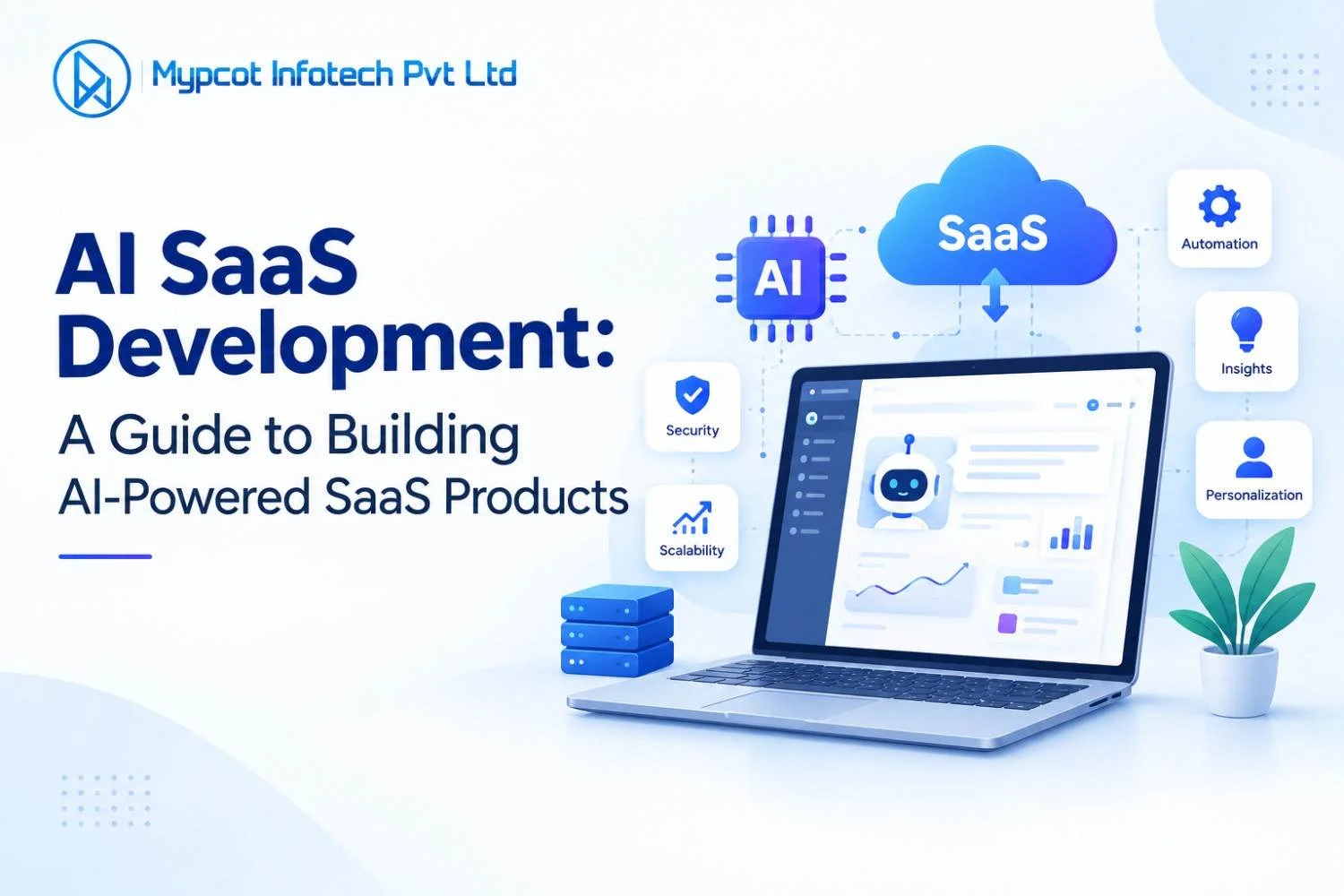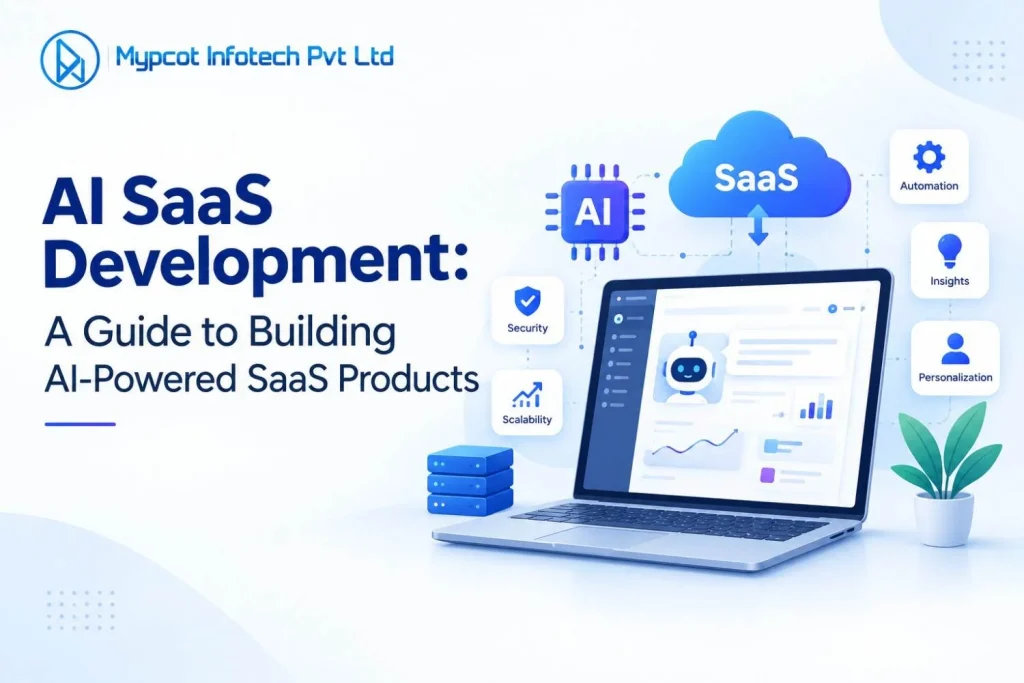
SaaS, or Software as a Service, is software that people access online instead of installing and maintaining it on their own devices. With AI integration, this model can go beyond just executing preprogrammed functions. It can interpret text and data, create text and data, identify patterns, make predictions, respond to queries or automate portions of a workflow.
That’s the vision of AI SaaS products. However, making this work as a helpful business solution requires more than just plugging in an AI model. AI SaaS development involves choosing the right use case, validating the product, designing the right architecture, managing AI costs, protecting data, and building for scale.
In this guide, we’ll explore how businesses and startups can take an AI SaaS idea from concept and MVP to a reliable, scalable product.
Table of Contents
ToggleWhat Is AI SaaS Development?
SaaS, or Software as a Service, allows users to access software through the internet without installing or managing it on their own systems. AI brings an extra dimension to this software, enabling it to comprehend data, recognize patterns, create content, respond to inquiries, and automate tasks.
By integrating all of these capabilities, AI SaaS development can result in software applications that are more intelligent and responsive to consumer needs than those capable of following a set of instructions.
AI-Enabled SaaS
AI is added to an existing SaaS product to improve specific features or workflows.
- Smart search and recommendations
- Automated reports and summaries
- AI-powered customer support
AI-Native SaaS
AI is the foundation of the product and drives its main functionality.
- LLM applications
- AI agents
- RAG-based tools
This distinction affects the product’s architecture, AI model selection, development cost, and scalability.
Why Are Businesses and Startups Building AI-Powered SaaS Products?
AI adds value when it can help users to complete difficult or repetitive tasks, or tasks that involve a lot of data, more efficiently. That’s why companies are turning to AI-driven SaaS solutions that enhance workflows, insights, and user experiences over the mere addition of AI features.
1. Automate Work
AI can automate tasks like sorting requests, data extraction, summarization, and answering frequently asked questions. This minimizes the manual effort and saves precious time.
2. Find Better Insights
AI can analyse large datasets, identify patterns, detect unusual activity, and support forecasting. Users get useful insights without spending hours analysing data manually.
3. Personalize Experiences
AI can adapt to user actions, preferences, and history to provide more relevant recommendations, content, search results, and actions.
4. Understand Complex Data
Documents, emails, reports, and other unstructured data can be processed by AI. Technology like RAG can also enable SaaS products to respond with business-specific information when answering questions.
5. Improve Decisions
AI can help to collate the relevant information, identify key patterns, and recommend potential actions. It helps users to make quicker, more informed decisions.
The secret is to solve the right problem. It is important to implement AI because it benefits the user in some meaningful way rather than just because competitors are doing it. This mindset should be applied throughout every phase of creating an AI SaaS solution.
Before You Start AI SaaS Development, Validate the Problem
Sometimes the need for AI is already visible in the way your business works. Your team could be doing the same tasks for hours, or your customers might have questions with the same answer, or critical information may be sitting inside documents and data. These are indicators to look at.
With AI SaaS development, such issues can be transformed into smarter workflows by automating repetitive tasks, locating information quickly, and supporting individuals in making better decisions. It’s not the question of where to put AI; it’s the question of where our business is doing more work than it needs to be.
The Features Worth Building Into Your AI SaaS
The key to a successful AI SaaS product is the inclusion of features that actually address user needs. Here are some of the important features to watch out for, ranging from AI automation to natural-language interaction, RAG, personalization, predictive insights, to human control.
- Intelligent Automation
AI automation can streamline workflows by handling repetitive tasks like request processing, information sorting, summarization, and workflow updates, thus saving time.
- Natural-Language Interaction
By using a simple interface and instruction set, users can interact with an AI-powered application, making complex software easier and more intuitive to handle.
- Business Knowledge Access
RAG (Retrieval-Augmented Generation) enables the product to pull data from company records, databases, and knowledge bases to create an answer.
- Smart Recommendations
AI can be used to interpret user behavior and preferences to deliver personalized content, suggestions or next steps within the SaaS application.
- Predictive Insights
Machine learning and AI models can analyze business information to recognize patterns, and can help make forecasts, identify risky situations, and make decisions regarding customer retention.
- Human Control
Users can verify the results of AI generation with review, approval, editing, and feedback options, particularly for sensitive and business-critical tasks.
Choosing the Right Technology and AI Architecture
The choice of technology will depend on the goals of your AI SaaS product. One effective approach to developing an AI SaaS is to select the appropriate mix of application technologies, AI models, data systems, and cloud resources that meet performance, security, scalability and cost requirements.
- Frontend & Backend
The front end provides the user experience; the back end handles business logic, APIs, user accounts, data, and integration with AI. Depending on the requirements of the product, they can use frameworks like React, Next.js, Node.js or Python.
- Databases
Structured data is stored in a traditional database, including data such as users, payments, and application data. The value of a vector database is in situations where the product requires semantic search or retrieval of relevant data in documents and knowledge bases.
- Direct LLM Integration
Direct LLM integration works well for content generation, summarization, translation, Q&A, and AI assistants. It is a suitable alternative when the AI system’s primary purpose is to provide general knowledge and not access to private business data.
- RAG Architecture
RAG (Retrieval-Augmented Generation) can be useful in scenarios that require an AI-driven application to engage with corporate documents, knowledge, or dynamic data. It retrieves pertinent information before generating a response, thereby helping to make more meaningful responses.
- Fine-Tuned Models
Fine-tuning may be considered for general AI models that need a special task or desired output style. When standard prompting can’t provide the required behaviour, it is useful.
- AI Agents
AI agents can be used in workflows that require multiple steps, tools, or decisions. They can help drive an AI SaaS application beyond just generating responses and tie actions to the task.
- Cloud Infrastructure
The cloud infrastructure is the backbone of an AI SaaS platform, providing the power, storage, databases, security, and scalability needed for it. It is also expected to be flexible enough for future expansions in user base, performance requirements, and ongoing AI inference costs.
How to Choose an AI SaaS Development Company?
Evaluate an AI SaaS development company on its ability to understand your business, choose practical AI solutions, control complexity, and build a product that can perform reliably as usage grows. Here’s what to look for:
- Knowledge of AI & SaaS: Experience with LLMs, RAG, AI agents, APIs, scalable SaaS architecture.
- Business Understanding: Ensuring the right AI features, users, workflows, and business goals are in place.
- MVP Planning: List down the essential components that will aid in product validation without luxuries.
- Security & Scalability: Strong data security and scalable design to accommodate growing users, data, and AI usage.
- Post Launch Support: Ongoing model monitoring and optimization, model changes, and product improvements.
The most important aspects of the quality of AI SaaS development partners are their technical expertise, product strategy, and their ability to build, launch, and grow an AI SaaS product.
Conclusion
The actual challenge of an AI SaaS product starts after the technology is developed. Is it capable of addressing the problem more quickly, consistently, more trustworthy, and less expensive as usage increases? When developing AI SaaS, you can rely on these questions as a guideline.
At Mypcot Infotech, businesses can leverage AI opportunities through the right product strategy and AI software development expertise, transforming them into useful, scalable SaaS products that deliver tangible value.