The interesting part of artificial intelligence is not that a mobile app can do more. However, it can smartly handle tasks that once required human interpretation. An application can learn from past interactions, understand spoken requests, extract information from documents, or even generate responses based on context.
Each compatibility depends on a different approach, along with the choice affects everything from development costs and data handling to speed and reliability.
So, exploring AI technologies in mobile app development means looking beyond features in order to understand how these systems work, where they perform well, and when their limitations matter. Let’s explore top AI technologies in apps.
Table of Contents
ToggleWhat Is AI in Mobile App Development?
AI in mobile application development refers to the implementation of artificial intelligence technologies that enable applications to process data, identify patterns, interpret user input, and generate appropriate responses.
Traditional rule-based applications follow predefined instructions, while AI-powered applications can interpret inputs, identify patterns, and adapt their outputs based on context. Many applications combine rule-based logic with AI capabilities. This makes AI useful for applications truly in need of prediction, personalization, and even interpretation.
For example, artificial intelligence in mobile apps can help businesses:
- Customise experiences: Analyse user behaviour and suggest products.
- Set up expectations: Warn about odd banking activities.
- Adjust functionality: make learning exercises suitable to the learner.
Here, the key difference is that conversational apps follow fixed instructions, while AI-powered features can make data-driven decisions within defined limits.
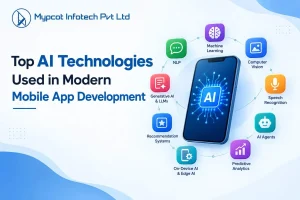
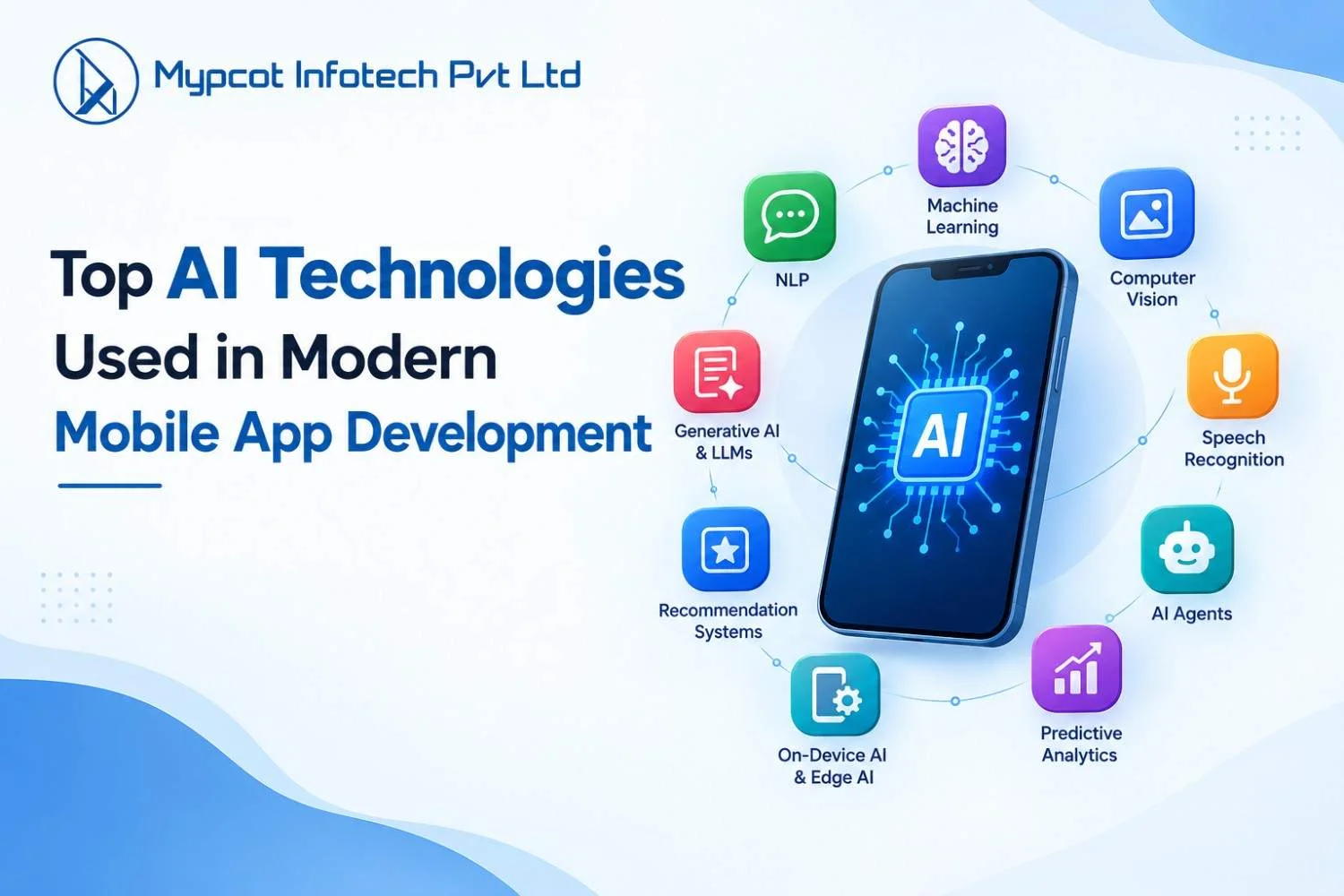
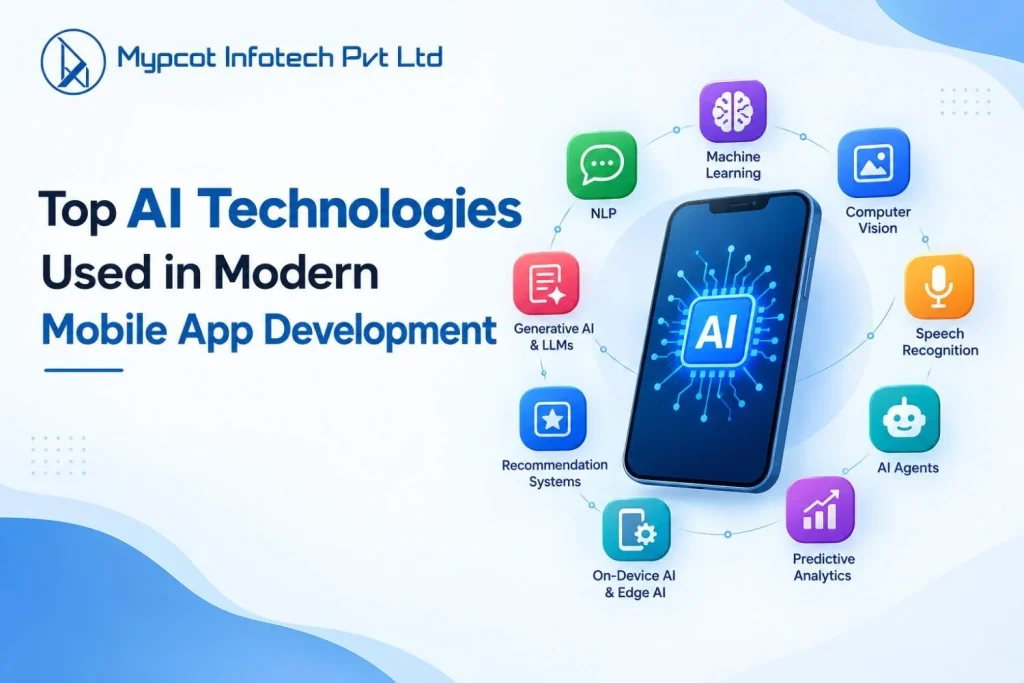
Top AI Technologies Used in Mobile App Development
Each AI technology solves a different problem, from recognizing patterns to understanding language and automating tasks. Actually, the right AI technologies in mobile app development depends on the app’s purpose, available data, privacy requirements, as well as performance needs. Here are top technologies:
1. Machine Learning (ML)
Machine learning identifies patterns in data in order to make predictions. Machine learning in mobile apps supports fraud detection, activity tracking, and personalization.
For example, a fitness app can analyse workout history to suggest realistic goals.
2. Natural Language Processing (NLP)
NLP helps apps interpret written language and identify user intent. NLP in mobile apps supports:
- AI chatbots: Answer common questions.
- Sentiment analysis: Interpret customer feedback.
- Text processing: Summarise messages and extract information.
3. Generative AI and Large Language Models (LLMs)
Generative AI creates new content, including text, images, audio, and other media. Large Language Models (LLMs) are a type of generative AI primarily designed to process and generate language. Mobile applications can use these technologies for study assistants, document summaries, and conversational support. Since AI-generated outputs can be inaccurate, important information should be verified.
4. Computer Vision
It allows apps to understand what is being captured from images and videos. Mobile apps that use computer vision can enable scanning of documents, visual search, identification of products, and defect detection. The accuracy will vary with the quality of the image and the conditions under which the model is used.
5. Speech Recognition and Voice AI
Speech recognition converts spoken words into text, while voice AI enables voice-based interactions such as voice search, dictation, and hands-free controls. Speaker recognition, where implemented, can identify or verify a speaker. Accuracy depends on factors such as accents, background noise, and recording quality, while voice data must be handled with appropriate privacy safeguards.
6. Recommendation Systems
Recommendation systems rank and suggest content or items based on factors such as user preferences, behaviour, and contextual information. Shopping, streaming, and learning apps use these systems to personalize suggestions. Their effectiveness depends on the relevance of recommendations, the quality of available data, and how well they meet user needs.
7. Predictive Analytics
Predictive analytics is a type of predictive modeling that relies on past data to forecast future outcomes. Predictive analytics within mobile apps can anticipate demand, recognize the possibility of customers’ attrition, and highlight atypical user activity. These estimates are used to inform choices, but do not ensure outcomes.
8. AI Agents and Intelligent Automation
AI Agents can perform multiple step actions by leveraging allotted tools, instructions and methods. Mobile apps can leverage AI agents for comparing travel options, scheduling appointments or coordinating connected services. When payments or sensitive information are involved, it’s important to obtain permissions and user approval.
9. On-Device AI and Edge AI
On-device AI works directly on a smartphone with the data, and edge AI works near the source of the data. On-device AI can speed up response times, provide offline capabilities, and minimize data transfers. The complexity of the model is, however, constrained by the amount of memory, processing power, and battery life on the device.
How AI Technologies Are Used in Real-World Mobile Apps
AI is useful when it enables an app to deal with real situations, rather than just carrying out pre-programmed actions. In all sectors, AI-powered mobile applications leverage data to enhance service offerings to be more relevant, responsive, and efficient.
- E-commerce: AI can track evolving consumer preferences, enhance product search capabilities, and assist retailers in demand management during peak seasons. E-commerce: AI can learn about shifting consumer interests and provide better product information, and can ease retailers during the busy season.
- Patient care: apps may support patients by enabling them to keep track of long-term health trends, organize health-related information, and track follow-up appointments, but clinical decisions should be made by healthcare providers.
- Banking: AI can help identify potential risks during transactions at the moment they happen, understand new fraud trends, and enhance the security without blocking legitimate transactions.
- Education: Apps can detect common issues students have in learning and adapt their practice activities to assist the student in reinforcing important concepts in their learning.
- Travel: AI can produce flexible travel plans, considering budget, interests, local circumstances, and time limits, and propose alternatives when plans change.
Benefits of Integrating AI into Mobile Apps
The actual benefit of AI in producing mobile applications is its ability to make the application a lot more responsive without sacrificing a lot of effort. Well-designed AI can optimize the customer experience and run the business smoothly.
- Customised Experiences: AI can adjust content, functions, and suggestions to user preferences to make it easier for individuals to locate what they need.
- Better Customer Support: AI assistants can guide consumers to customer support for routine customer service requests and handle extremely complicated or sensitive requests, thereby freeing up time for human customer service agents.
- Improved Workflows: AI can minimize repetitive tasks, streamline information processing, and support teams in handling larger workloads.
- Better Access: apps may be more accessible using voice control, speech-to-text, image descriptions, and language-adapted access for users with special needs.
- Better-Informed Decision-Making: AI can help identify trends in user behavior and app performance, allowing businesses to optimize their apps and anticipate user needs, among other things.
But it’s possible to obtain these benefits only when the data that backs them up is of high quality, the implementation is efficient, and it is continually measured and assessed. AI-powered mobile apps can be designed to do more than just be convenient – they can help users make better decisions, complete specific tasks more efficiently, and make services more useful, all while ensuring user privacy and control.
How to Choose the Right AI Technology for Your Mobile App
Follow these steps to select an AI solution that fits your app’s goals, technical requirements, and budget.
Step 1: Define your goal
Identify the problem AI should solve, such as improving search, personalising content, or reducing support workload. Set a measurable outcome before development begins.
Step 2: Assess your data
Check whether your data is accurate, relevant, sufficient, and legally usable. Poor-quality data can undermine predictions and recommendations.
Step 3: Match the technology to the task
- Machine learning for predictions.
- NLP for understanding text.
- Computer vision for image analysis.
- Generative AI for creating content.
Step 4: Choose cloud or on-device AI
Cloud processing supports complex models, while on-device AI can reduce delays, support offline use, and keep certain data on the device.
Step 5: Estimate the total cost
Account for development, infrastructure, model usage, security, maintenance, and future updates, not just the initial build.
Step 6: Test with a small prototype
Measure accuracy, response time, user experience, and cost using realistic scenarios before investing in a full rollout.
Step 7: Plan for scalability
Ensure the solution can support growing user numbers, changing data, and additional features without compromising performance.
Experienced AI mobile app development services can help businesses assess these requirements and choose a suitable architecture. The best approach is to validate one use case first, then scale when the results demonstrate genuine value.
Conclusion
The promise of AI is that it can enable mobile apps to do more than just follow commands. They can make informed decisions, do tasks with less effort, and access services that better meet their needs.
Opting AI technologies for mobile app development involves a delicate balance of innovation and accuracy, privacy and business objectives. Talk with Mypcot Infotech to learn how you can leverage the right AI approach to transform your mobile app vision into a valuable and scalable solution.