Business software influences how departments exchange information, automate tasks, track performance, and make decisions. Yet, a solution that works for one company may not suit another with different workflows, legacy systems, or even compliance requirements.
When evaluating a custom enterprise solution vs. off-the-shelf solutions, the business must consider how well each choice handles these operational needs.
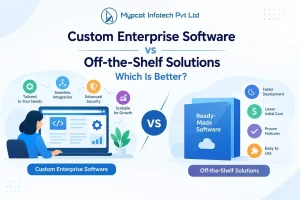
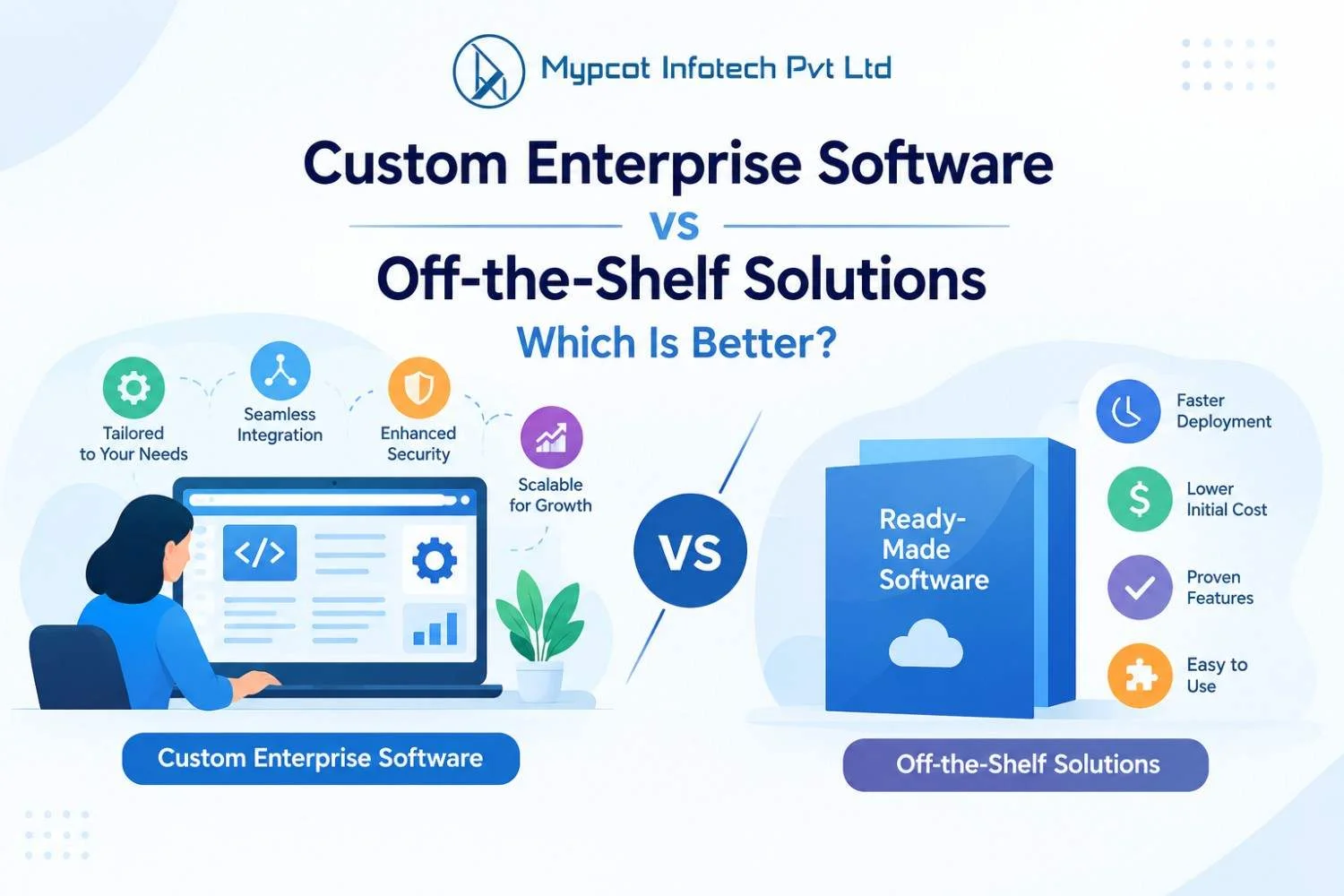
Ready-made software provides proven features with faster deployment. On the other hand, custom development allows functionality and integrations to be built around specific requirements. So, the best choice depends on the complexity of your operations, implementation budget, and plans for future growth.
Table of Contents
ToggleWhat Is Custom Enterprise Software?
Custom enterprise software is developed around a company’s particular operational requirements instead of relying on predefined features. It helps companies manage processes that standard applications may not fully accommodate.
Common applications include:
- ERP systems:
Coordinate business functions like finance, procurement, and operations.
- CRM platforms:
Handle customer information, sales activities, along with service interactions.
- Inventory management:
Track stock movements, materials, as well as product availability.
- Workflow automation:
Handle business-specific tasks, approvals, and other internal processes.
- Business intelligence:
Organize operational data into useful reports for decision-making.
For example, a manufacturer is producing customized orders that need a system that connects product specifications with product records and quality checks. Custom development can bring these requirements into one application that is built around the company’s actual workflows.
What Is Off-the-Shelf Software?
Off-the-shelf software applications are pre-packaged software that meets general business needs in several organizations. Rather than building the system from the ground up, a business can usually subscribe to the system, purchase a per-user license, or a single license for the specific business product.
Common examples include:
- Accounting Software: It is used for managing invoices, costs, payments, and financial records.
- Human Resource Management Platforms: Manage employee records, attendance and leave, and payroll.
- Project Management Tools: Organize teams and tasks, project deadlines, and communicate about projects.
- Customer Relationship Management (CRM) Platforms: Data related to customers, sales interactions, and activities.
One of the advantages of using off-the-shelf software is that it is fast. These solutions can be used in a business without a long development process because they have tested functionality that can meet the specific business needs.
Custom Enterprise Software vs Off-the-Shelf Solutions: Key Differences
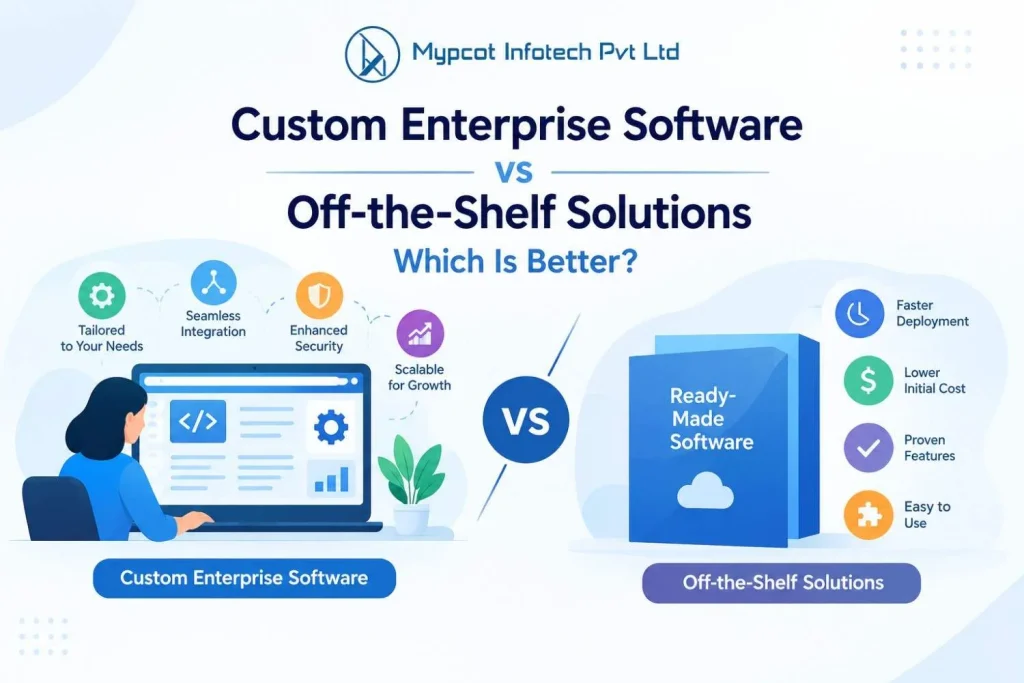
The choice between custom enterprise software vs off-the-shelf solutions depends on how closely the software needs to match your business processes, budget, and technical requirements.
| Comparison Factor | Custom Enterprise Software | Off-the-Shelf Software |
| Initial Cost | Higher development investment | License or subscription fees |
| Implementation Time | Longer due to development and testing | Faster to configure and deploy |
| Customization | Built for specific requirements | Limited to available options |
| Scalability | Can scale based on architecture and available resources. | Depends on product capabilities, infrastructure, and licensing limits. |
| Integration | Tailored integrations | Available APIs and connectors |
| Maintenance | Managed by business or development partner | Vendor-managed |
| Security | Security controls can be tailored to business requirements. | Security depends on vendor controls, configuration, and updates. |
| Long-Term Cost | Development and maintenance costs | Recurring fees and additional costs |
Advantages of Custom Enterprise Software
Custom enterprise software is valuable when standard tools cannot properly support the way a business operates. Its benefits go beyond customization, helping teams reduce friction and manage complex processes more effectively.
Tailored Business Workflows
Pre-defined approvals, data specifications, and rules can be leveraged to develop software. For instance, if an order is worth a specific amount or more, a distributor can automatically accept that order, eliminating the need to manually approve it via email.
Greater Flexibility and Control
Rather than adapting to a predetermined product, businesses can manage the features, roles permitted to use the product and workflows. Requirements may change and modifications can be made to this.
Integration With Existing Systems
Custom Software Development can integrate ERP, CRM, inventory, payment, and internal systems, minimizing data duplication and ensuring data consistency.
Support for Long-Term Business Growth
New modules, workflows, and integrations can be added as operations expand, allowing the software to develop alongside the business rather than becoming a limitation.
Advantages of Off-the-Shelf Software
Off-the-shelf software offers several benefits. Off-the-shelf software has some advantages.
When a company’s needs are very similar to an existing product, off-the-shelf software is effective. It offers prebuilt functionality that organizations don’t have to develop and maintain.
- Faster Implementation
Ready-made platforms can be set up and put into operation rapidly, which is advantageous if teams must have a solution without a lengthy development cycle.
- Lower Initial Investment
Custom development might be more expensive, but licensing or subscription can help lower initial expenses. But recurring fees and add-ons should be taken into account.
- Established Features and Vendor Support
For the development of common features, mature products can reduce the need to build these in house as the functionality has been tested and documented, plus they are regularly updated and supported by vendors.
- Less Core Product Maintenance
The vendor usually performs core updates, bug fixes, etc., and the internal teams focus on business operations.
When Should You Choose Custom Enterprise Software?
Custom enterprise software makes sense when standard products create more limitations than value. It may be the better option when:
- Processes are highly specialized: Your workflows do not fit standard software.
- Multiple systems need to connect: You require tailored integrations across ERP, CRM, databases, or internal tools.
- Critical requirements are missing: Existing products cannot support essential functions without complex workarounds.
- You need roadmap control: Your business needs control over features, updates, and future development.
- Long-term value is clear: The operational benefits justify the investment in custom software development.
When Is Off-the-Shelf Software the Better Choice?
Off-the-shelf software is often the practical choice when a business needs proven functionality without building a system from scratch. It fits well when:
- Quick Configuration and Deployment: The software can be configured and deployed quickly.
- Requirements are Standard: Most operational requirements are already met by existing features.
- There are Limited initial Budgets: Subscription or Licensing may lower initial investment.
- Functionality is Important: Products that are proven to be effective have features and vendor support.
- Internal Maintenance Should Remain Low: Vendor performs core update, fix, and product improvements.
Can You Combine Custom and Off-the-Shelf Software?
Yes. A hybrid software solution allows companies to leverage existing software solutions for common tasks and create custom applications for niche tasks. For instance, a business may choose to keep its accounting system or CRM software, but opt for custom software for its production system or internal operations. The main focus areas are on establishing a consistent and reliable integration, data flow, and maintenance of the systems.
How to Choose the Right Enterprise Software for Your Business?
It’s not about the length of the features list in the right software. It is the one that is simple enough to not get in the way of solving business problems. To make the decision use this framework:
- Map out the needs: Write down key workflows, pain points, users, and the workflows that need to be improved.
- Evaluate the different software solutions available: Make sure you evaluate current enterprise software solutions based on the mandatory features and not optional ones.
- Determine the actual expenses: Subscriptions or development, integrations, training, maintenance, upgrades, and changes in the future.
- Check security and integration: Assess data controls, compliance requirements, APIs, and compatibility with your current systems.
- Plan for growth: Check that the solution can accommodate additional users, increased workloads, and evolving business processes.
- Test before investing: Conduct a pilot or proof of concept with a real business process to pinpoint problems early.
Conclusion
The best software choice isn’t between custom and ready-made by default. It’s about the solution that suits your workflow and integrates with your systems while being practical as your business expands.
Off-the-shelf software may have tried-and-tested capabilities, whereas custom enterprise software can offer more control for specialized requirements. To find the solution that is in line with your business goals, you can always consult Mypcot Infotech to help you do so.