Live events aren’t exactly what they used to be. Earlier most of the work happened behind the scenes with calls, spreadsheets, along with last minute coordination. But now, everything moves really fast, and expectations are higher.
Nowadays, attendees want updates instantly, easy access to schedules, as well as a smooth experience from start to finish. Now, this shift has pushed live events app development into the core of event planning.
In this blog, we’ll explore how exactly these apps are built, what features are there that truly help, what kind of cost is involved, and how live streaming event app functionality keeps everything connected in real time.
Table of Contents
ToggleWhat is Live Events App Development and Why It Matters Today
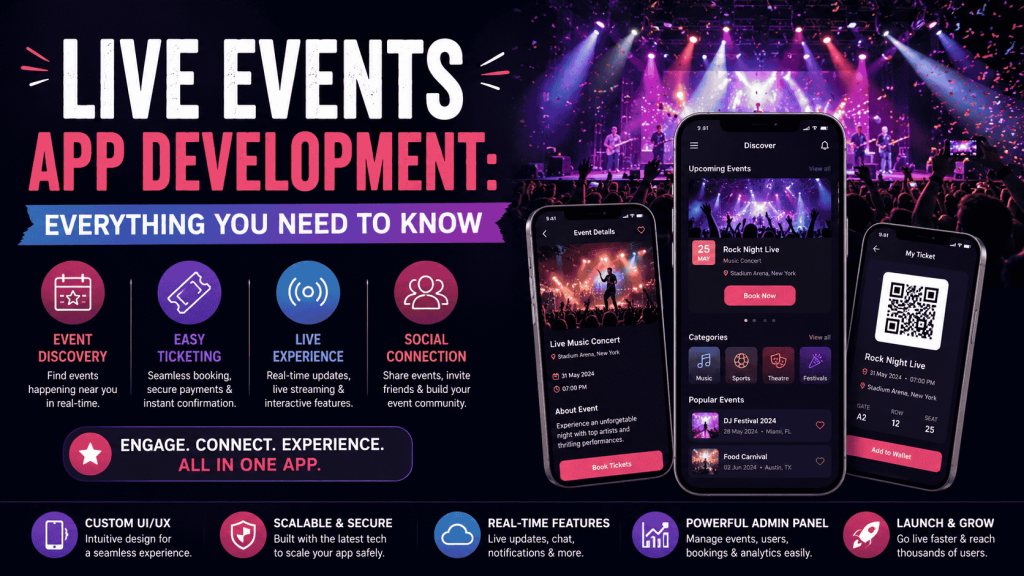
Live events app development is actually the process of building digital platforms. It manages events in real time, from registration and schedules to attendees’ engagement and updates. This platform brings everything into a single platform so that organizers can run events smoothly and attendees can access information without any confusion.
A live event app primarily acts as a central hub for coordination and communication during an event.
Types of Event Apps
- Physical event apps: These are used on-ground for check-ins, schedules, maps, along with updates.
- Virtual event apps: Virtual event applications focus on live streaming, chats, and even online sessions.
- Hybrid event apps: These apps combine both versions of physical and virtual experiences in one platform.
Why It’s Growing
Live events application development is in high demand as events now need real-time updates, better engagement, and digital convenience.
Hybrid events and online participation have truly made apps essential for smooth execution and wider reach.
Real Use Cases
- Concerts use these apps for schedules and live updates.
- Webinars use live streaming and interactive app features.
- Conferences for networking and session tracking.
- Several exhibitions for navigation and exhibitor details.
Nowadays, these applications are no longer optional. But, these apps have become part of how modern events function.
Key Benefits of Live Events App Development for Businesses
The development of live events apps has become an essential component of business planning and execution of events in the present day. It is not only about the control of registrations or schedules anymore.
A robust platform enhances interaction, eases communication, and provides a clear understanding of the actual performance of an event in real-time.
- Better Audience Engagement
One of the greatest advantages is the enhanced interaction by the use of such facilities as interactive polls, live questions and answers sessions, feedback, and personalized agendas. Equipped with tools that are likely to be available on a mobile application when attending a live event, viewers are not merely observing an event, but are involved in it, which in turn elevates attention and engagement.
- Real-Time Communication
Event conditions can change quickly, and communication must keep up with that. Live event application provides real-time updates to changes in the schedule, speakers, or venue. Such characteristics as push notifications and in-app messaging minimize confusion and ensure everyone is on track, avoiding delays.
- Revenue Generation Opportunities
Live events development broadens several sources of Revenue, including ticket purchases and access to premium content, among others. Numerous companies have put together event booking app creation patterns with paid workshops, sponsored talks, and in-application commercials, transforming events into systematic Revenue systems rather than an area of single event.
- Stronger Brand Visibility
An event management development solution is a well-planned application that enhances the brand penetration during the event journey. The brand identity is carried in every interaction, from registration screens to live sessions.
This repetitive exposure creates trust and enhances the memory even after the event is over.
- Data Collection and Insights
Access to real-time data is one of the most valuable things. Companies are able to monitor user activities, session popularity, engagement, and drop-off Points.
These are the insights that are usually backed by event analytics dashboards and which can be used to refine future strategies and enhance the overall planning of the event.
Must-Have Features in a Live Events App
With successful live event apps, it is not only the number of features that are different but the functionality of those features for the user. Friction reduction is what is needed in the case of live events app development. When users find it difficult at any point,
registration, navigation, or interaction, then they just give up. And here are the main user capabilities which really count:
- Easy Registration & Login
This is the initial communication, and it predetermines all that follows. A well-designed live event app maintains this process as fast and adaptable. The onboarding is easier with options such as email login, social sign-in, or OTP-based access.
Not only about speed, though. An organized registration system will also be able to record valuable information such as preferences, interests, or session preferences. This will aid in making the experience more personalized in the future, rather than making all the attendees the same.
- Event Discovery & Filters
When a user gets into the app, the user is supposed to be able to locate what he or she requires without having to scroll and scroll. This is where smart event discovery becomes important.
Navigation is facilitated by clear categories, search options, and filters by date, topic, speaker or location. This feature is necessary in case of larger events such as exhibitions or multi-track conferences. It is time-saving and enhances satisfaction in general since users do not feel lost.
- Booking of Tickets and Payments.
The app also serves as a ticketing platform for various events. Easy booking process directly influences conversions. Users lose momentum in the process when it becomes unclear or unsafe.
- A strong ticketing system includes :
- Multiple payment options
- Secure payment gateways
- Real-time validation of e-ticket or QR codes.
- Personalized Schedules
Not all of the people here are on the same agenda. Others may be interested in certain sessions, speakers, or activities. An excellent application should enable users to make their own schedule rather than imposing a fixed schedule.
This feature often includes:
- Add to schedule options
- Session reminders
- Overlapping session conflict warnings.
- It transforms a big, complicated event into a smaller, customized one to every user.
- Push Notifications
Punctuality in communication may or may not make the event a good one. Push notifications are how users can remain informed without the need to check the app all the time.
- These messages can be utilized in:
- Session reminders
- Last-minute changes
- Important announcements
- Promotional updates
When properly used, they ensure that the users are informed and entertained. They are noisy when misused, and moderation is key.
Types of Live Event Apps You Can Build
Live events apps are developed based on the type of event and the requirements of the users.
- Event Booking App: Ticket-oriented and event discovery, including booking, payments, and entry with QR. Perfect in concerts and paid shows.
- Virtual Event Apps: Constructed to support online events, including live streaming, chat, and access to sessions. Typical of online summits and webinars.
- Hybrid Event App Solutions: Integrates physical and virtual capabilities within a single application and caters to both on-site and remote participants.
- Conference App: Manages multi-session schedules, speakers, and networking. Most suitable for corporate and industry events.
- Community-Driven Event Apps: Created to be used continuously to connect with networking and not just one event.
- All types focus on different purposes, and thus the selection of the right type ensures that the app is focused and effective.
Step-by-Step Process for Live Events App Development
The development of live events apps should have a clear and realistic flow. These stages will be constructed one after another, enabling you to prevent
misunderstandings, unnecessary expenses and features.
Step 1: Audience Analysis and Market Research
The first step is to know your audience and what kind of event you are creating. A concert application will not operate in the same way as a webinar application.
This is useful to establish what users really require and what the current application is not doing well so you are creating something of value, not just an application that works.
Step 2: Identify Main Functionality (MVP Approach)
Rather than putting it all in one shot, it should be about an MVP. This implies the release of the minimum number of features, such as registration, schedules, and simple interaction. The advanced features and a complete product can be added in later iterations. when you learn what users want and use.
Step 3: Interactive UI/UX Design
The app must be easy to use on the initial tap. The user should be able to locate sessions, update or participate in events, without having to think a lot.
An easy-to-use and clean design will make the user experience entertaining and minimize abandonment during the event.
Step 4: Development (Frontend + Backend)
It is the place where the app is developed. The frontend is what the users can see, and the backend is what drives the data and performance. In the case of live events, it is focused on real-time updates, seamless performance, and secure integrations such as payments or streaming.
Step 5: Testing and QA
All should be tested out beforehand. This will ensure that the application is compatible with devices and will be able to support real-time usage with minimal downtime and low latency, particularly when all events are in high demand.
Step 6: Launch and Deployment
Once it is prepared, it is released on the necessary platforms. The next step is performance monitoring, troubleshooting, and refining the app with actual user feedback to make it more effective with time.
Conclusion
Today, live events require more than just simple planning. They should have systems that are capable of managing real-time coordination, maintaining the attention of attendees, and providing an uninterrupted experience throughout the event. This is what properly developed live event applications can offer. It streamlines the processes, enhances interactions, and provides companies with clear guidelines to make improved decisions in future events.
Rather than looking at it as an additional layer, it might be better to consider it as a long-term investment that will have a direct and significant impact on the way your events perform and scale.
To develop a solution that is reliable and future-ready, collaborating with a team of experienced professionals, as is the case with Mypcot Infotech, can assist you in transforming the appropriate idea into a viable and performing event app.