
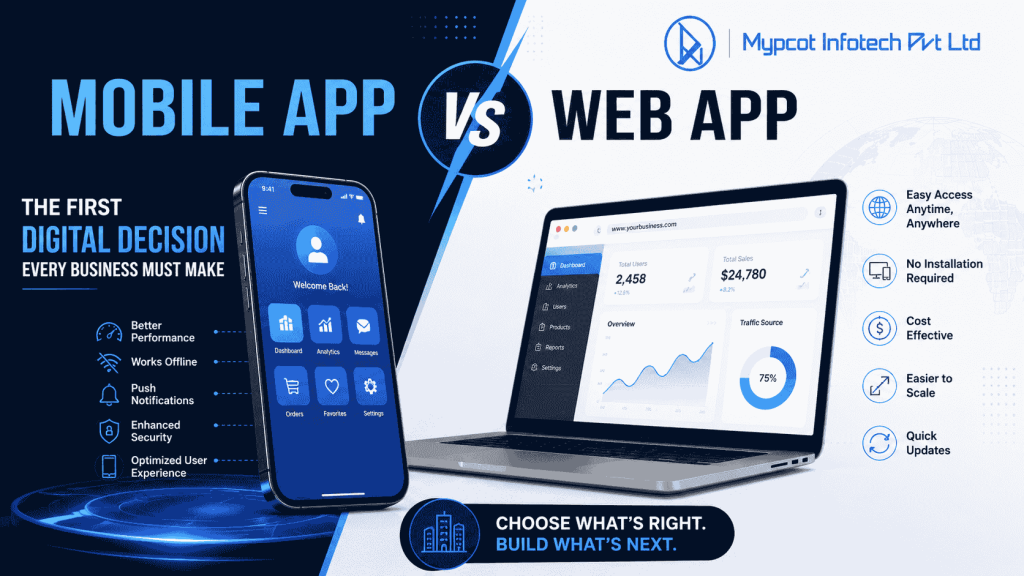
Mobile App vs Web App: The First Digital Decision Every Business Must Make

Mobile App vs Web App The First Digital Decision Every Business Must Make

Understanding mobile app vs web app is one of the first steps businesses should take before even investing in a digital product. Here, the right choice can influence customer experience, operational efficiency, along with the ability to scale in the future. For example, an e-commerce business may rely on a mobile app in order to increase customer engagement through personalized offers and notifications. 

On the other hand, an enterprise may need a web app to handle complex processes and data. In this blog, we will compare mobile apps and web apps, thoroughly discuss their advantages, costs, business use cases, and key factors in order to help you choose the right platform for your business needs. 

Mobile App vs Web App: Understanding the Fundamental Difference

Businesses need to know the difference between a mobile application vs. web app in order to decide which one to use to accomplish a goal. Mobile apps are optimized for customization and user experience, while web apps provide more device and browser portability and flexibility.

Software Development · Mumbai

Transform Your Business With the Right Technology.

Custom apps, websites & AI solutions — get a free consultation and project estimate from our Mumbai team.

+91 82088 57739 · sales@mypcot.com

What Is a Mobile App?

A mobile app is an application designed for a smartphone or tablet and made available through a mobile app store such as the Google Play Store or Apple App Store. Companies generally go for mobile app development when they want to improve the user experience, customer retention, and make use of the capabilities of smartphones. From an e-commerce app to create a personalised shopping experience, to a banking app to allow safe transactions, to a healthcare app to simplify appointment scheduling, mobile apps are developed to maintain consumer engagement with a brand.

The most popular uses of mobile apps include:

  • E-commerce and retail
  • The financial and banking sector.
  • Healthcare and telemedicine
  • Logistics and food delivery

What Is a Web App?

A web app is an interactive application that runs in a web browser without being downloaded or installed. Businesses usually opt for web app development when they require access to their application, simplicity of maintenance, and multi-customer support on various devices. Whether used in SaaS applications, customer portals, business dashboards, or enterprise management systems, web apps enable a seamless user experience and streamline operations.

Web Apps are typically used in the following applications:

  • SaaS platforms
  • Customer portals
  • Business dashboards
  • Enterprise management systems

Mobile App vs Web App: Key Differences Businesses Should Understand

Understanding mobile app vs web app starts with comparing their core differences. Here’s a quick overview to help businesses choose the right platform.

Comparison FactorMobile AppWeb App
AccessibilityRequires installationBrowser-based access
PerformanceFaster and optimizedDepends on browser and internet
User ExperiencePersonalized experienceResponsive across devices
Device FeaturesBroader access to native device capabilitiesLimited device capabilities
Development CostUsually higherUsually lower
MaintenanceRequires app updatesInstant updates
User EngagementStronger re-engagement capabilitiesBroader accessibility
Best ForCustomer-facing applicationsBusiness platforms and portals

Mobile App vs Web App: Which One Is Right for Your Business?

It depends on your business needs. In the case of mobile app vs. Web app, you should take your business objectives, target audience, customer behavior, features needed, budget, and scalability into consideration. The platform that is best suited to those factors will give you the greatest return on your investment.

The nature of your business and the industry you’re associated with are other crucial factors. For startups, it might be wise to begin with a web application for speedy entry into the market, while for a growing business or established brand, having a mobile app can help build a stronger relationship with customers and retain them.

When Should Businesses Choose a Mobile App?

For businesses seeking to offer a more personalised experience, engage customers and tap into the capabilities of smartphones, a mobile app is the perfect solution. Below are some of the most significant circumstances where mobile application development is beneficial.

When Customer Engagement is a Priority

When your business engages customers on a regular basis, a mobile app can help with deeper relationships and keep customers coming back to your business through:

  • Push notifications for timely updates
  • Personalized recommendations
  • Implementing customer loyalty and rewards programs.

Ideal for: Retail, Food Delivery, Fitness, Healthcare companies.

In situations where Your Business Needs Deeper Device Integration

A mobile app is recommended when your services require deeper or more consistent access to device-specific capabilities.

  • The global positioning system is used for real-time location tracking.
  • This camera is used to take pictures and upload to the Internet.
  • The ability to access secured areas with biometric devices.
  • Bluetooth connectivity
  • Reliable offline functionality

Ideal for: Logistics, Travel, Healthcare and Field Service businesses.

If performance and speed are a priority

Opt for a mobile app when instant and seamless user experience is the key to success.

  • Faster loading times
  • Smooth navigation
  • Better responsiveness
  • Enhanced user experience

Ideal for: Banks, online retailers, media companies, and gaming sites.

When Should Businesses Choose a Web App?

For businesses that value accessibility, speed, and effective business practice, a web app is the perfect option. When users should be able to access an app without downloading, investing in web application development is the perfect choice.

When accessibility is more important than installation

If your aim is to make your platform accessible, then a web app will provide the flexibility that users are expecting.

  • Use it from any desktop, laptop, tablet, or mobile browser.
  • No installation or downloads required
  • Rather easy to access from nearly any type of gadget

Ideal for: Business portals, SaaS applications, and online tools.

When Faster Launch and Updates Matter

A web application allows companies to deliver new features and capabilities rapidly and at reduced maintenance costs.

  • Developed and deployed in a shorter amount of time
  • Automatic updates that do not require any action by the user.
  • App store approval not necessary
  • Easier long-term maintenance

When Managing Complex Business Operations

When it comes to Web application development, it is ideal for businesses that deal with huge amounts of data, users, and workflows.

  • CRM and ERP systems
  • Admin dashboards
  • Analytics platforms
  • Employee management systems

Ideal for: Businesses, Software-as-a-Service providers, educational institutions, and organizations with intricate business processes.

Software Development · Mumbai

Transform Your Business With the Right Technology.

Custom apps, websites & AI solutions — get a free consultation and project estimate from our Mumbai team.

+91 82088 57739 · sales@mypcot.com

Mobile App vs Web App: What Should Businesses Choose at Different Growth Stages?

At different stages of your business, depending on your customers’ expectations and growth plans, you’ll want to choose between a mobile app vs web app. The following are the best ways to do it at each stage.

  1. Startups: Validate Before You Scale

In the initial stages, start-ups need to test their concept with a minimum amount of investment. Developing a web app or MVP allows you to gauge demand, gather end-user feedback, and get your product to market in a timely fashion. When the product starts to attract customers and their participation, the next step is investing in a mobile app.

  1. Small and Medium Businesses: Build Around Customer Needs

SMBs need to select a platform according to how their customers relate to their business. A web app is great for booking systems, portals, or business management; a mobile app works best to enhance customer engagement, loyalty, and repeat business.

  1. Enterprises: Use Both Platforms

For large businesses, both solutions can be of benefit. Web applications streamline internal processes and data management, and mobile applications enable customers, sales teams and field staff to remain connected at any time, anywhere.

  1. E-commerce Businesses: Reach More, Retain Better

A web app can drive new customers to e-commerce brands because they are more easily accessible, whereas a mobile app will retain customers, providing them with personalized experiences, push notifications, and quicker shopping.

  1. SaaS Businesses: Start with a Web App

The majority of SaaS companies start with web application development as it provides a lot of functionality and can be accessed from various devices. The more people use a mobile App, the more it can interact with them by issuing notifications and providing easy access to key features.

Mobile App vs Web App: Cost Comparison for Businesses

The cost of mobile app development and web application development depends on factors such as features, complexity, integrations, security, and maintenance. Here’s a quick comparison.

Cost FactorMobile App DevelopmentWeb Application Development
Features & ComplexityVaries by functionality and platformsVaries by functionality and workflows
UI/UX DesignMobile-first interfaceResponsive web interface
BackendAPIs, database, and server setupAPIs, database, and server setup
IntegrationsMaps, payments, notificationsCRM, ERP, payments, APIs
SecurityApp and user data protectionWeb and user data protection
MaintenanceRegular app updatesHosting and ongoing updates

Conclusion

There is no one-size-fits-all solution when it comes to mobile app vs. web app. The ideal platform is the one that will support your business as it expands and grows your business and customers. 

Prior to development, it’s time to evaluate your goals to prevent wasting time and resources, and to maximize the outcomes. 

From developing your first digital product to making the most of an existing one, Mypcot Infotech can assist you in picking and creating the ideal solution for your company.

Related Articles

Leave a Comment