It’s truly exciting to bring AI into your business until you have to decide what exactly to automate, which tools to trust, and how to make them fit into your existing operations. Not every task needs AI, and not every solution delivers the result you expect.
Start with a real business problem, no matter if it’s repetitive work, frequent errors, or even slow decision-making. This helps you focus on AI solutions that smartly deliver measurable value rather than adding unnecessary complexity.
In this guide, we’ll cover the key steps in order to get started, from evaluating business readiness and choosing the right AI solution to managing implementation challenges, following best practices, and measuring return on investment (ROI).
Table of Contents
ToggleWhat Is AI Implementation in Business?
AI implementation in business means integrating artificial intelligence into daily operations to solve specific problems, improve decisions, or reduce manual work. It’s not simply picking up a tool; it’s about being able to embed it with your data, systems, or flows.
Businesses leverage generative AI to generate content and summaries, predictive AI to predict customer needs, and AI agents to manage multiple-step tasks, are just a few ways. Successful implementation of AI needs to begin by identifying opportunities for where the technology can help and then to experiment and pilot before finding the right opportunities for rollout and scaling.
Why Are Businesses Investing in AI Implementation?
Artificial Intelligence is not merely a trendy tech approach; it’s a solution businesses are adopting to solve problems. With the proper processes, AI can cut down on repetitive tasks, reveal trends in business data, and assist teams in responding more quickly to customers. What matters is how to do the work better – making decisions measurable and practical.
- Automating repetitive tasks: It can automate tasks that can be automated like interpreting invoices, typing data, categorizing documents, and generating report, but still it requires human input to do judgement-based tasks.
- Delivering Data-Driven Decisions: AI sifts through large amounts of data, identifies patterns, predicts consumer needs, and uncovers trends to support data-driven business decisions.
- Improving the Customer Experience: AI-powered chatbots and suggestions for businesses can respond more quickly, offer relevant ideas and recommendations, and offer support outside of working hours; businesses can also pass on more complex and sensitive issues to a team of human agents.
- Improving Operational Efficiency: By analysing workflows, AI can pinpoint inefficient processes and repetitive delays, and propose optimisations to streamline workflows, reduce unnecessary tasks in daily business processes, and enhance resource utilization.
Remember: The key to achieving results is selecting the right use case, ensuring accurate data, embedding AI into current systems and monitoring over time.
Step-by-Step AI Implementation Process for Businesses
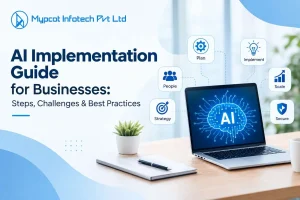
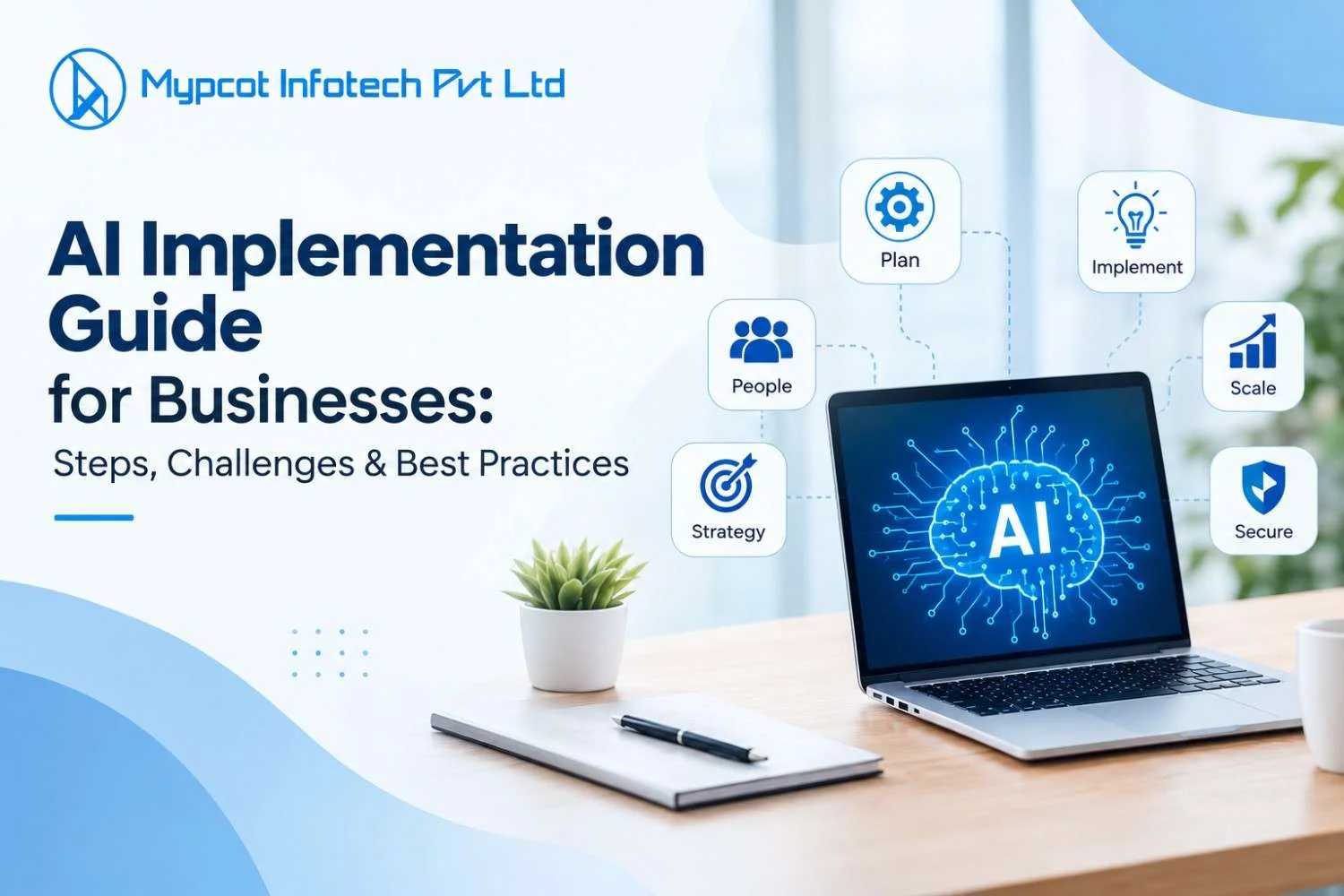
A practical AI implementation strategy starts with a clear business problem and focuses on measurable results. Follow these eight steps to implement AI effectively.
Step 1: Identify a Business Problem
Identify the activities that take unnecessary time, create mistakes or defer decisions. Establish a clear target, like quickening the invoice process.
Step 2: Assess AI Readiness
Evaluate your data, systems, budget and team capabilities. Be sure to find out security, privacy, and integration needs before investing.
Step 3: Choose the Right AI Solution
Match the technology with the task. Contrast the cost, accuracy, and business requirements of generative AI, predictive AI, AI agents, and existing tools.
Step 4: Prepare Your Data
Correct records that are incomplete or inconsistent. Signify data ownership, access and privacy protections to ensure trustworthy AI outputs.
Step 5: Test With a Proof of Concept
Conduct a small-scale test with realistic data. Measure accuracy, processing time, and total implementation and operating costs against the expected savings or additional revenue before expanding.
Step 6: Integrate AI Into Workflows
Integrate AI with appropriate CRM/ERP/support applications. Specify the need for human approval and run integrations prior to launch.
Step 7: Train Employees
Guide teams to confidently adopt AI, validate outputs and grasp its boundaries. Collect input as the rollout progresses.
Step 8: Monitor and Improve
Monitor accuracy, costs, processing time, and error rates. Utilize these outcomes to enhance the refinement of your AI implementation procedure and hold business value.
Common AI Implementation Challenges for Businesses
AI implementation can fall short when businesses overlook data quality, integration, or employee readiness. Addressing these challenges early helps reduce risks and improve returns.
- Poor Data Quality: Incomplete data leads to unreliable predictions. Assess data sources and set data governance.
- Legacy System Integration: Older software might not integrate with the latest AI tools. Test compatibility prior to deployment.
- Increasing Implementation Costs: Development, integration and maintenance are all costs. Start with a small pilot and measure ROI.
- Unfamiliar Tools: Employee resistance. Train employees and offer practical training.
- Sensitive Data Protection: Data should be protected from security and compliance risks. Implement access control, security audit and manual monitoring.
AI can generate incorrect or misleading outputs. Validate results against reliable sources, introduce human review for high-impact decisions, and monitor accuracy and error rates.
AI Implementation Best Practices
The proper approach to AI implementation is not simply a matter of which tools are at the present time. It’s about knowing what areas of your business AI can truly impact and ensuring it has an impact. Here are some useful tips to getting it right.
- Start small: Choose one task to work on, test, and then grow and scale.
- The goal of success: Set clear goals, for example to reduce processing times, prevent errors, or lower costs of operating expenses.
- Get ahead: AI Automation can deal with the tedious stuff to ensure that your employees stay in the loop when there is a human in the middle.
- Support reliable information: AI is dependent on data that is reliable and accurate; make sure the data is accurate and shielded sensitive information.
- Implements tools that fit into existing workflows and processes, not add to the to-do list.
- Be sure to pick the best AI provider: Attune to the features, security and integration, costs, technical support, and growth potential.
Implement AI Solutions With Mypcot Infotech
AI can be implemented effectively when it serves a specific business purpose. Mypcot Infotech can guide businesses in investigating AI options that fit their business objectives.
Some of the important aspects to take into account are:
- Workflow Automation: Avoid duplicate manual work.
- Data-driven Decisions: Make decisions from business data.
- Integrating AI: Link AI features to the current systems.
- Scalable solutions: Build around current needs and future growth.
Want to implement AI into your business? Talk to Mypcot Infotech about a solution that aligns with your objectives.
Conclusion
The real value of AI for your business lies in the value it can add to your business whether it’s lessening the manual workload, fast-tracking the decision-making process or optimizing workflows.
A clear implementation plan helps to ensure that successful implementation of the promising technology is achieved in realistic timeframes and is effective in holding costs, risks, and business objectives in focus.
Begin with a problem that needs to be solved, test the effect and expand on success. Partner with Mypcot Infotech to explore AI solutions that move your business forward.