
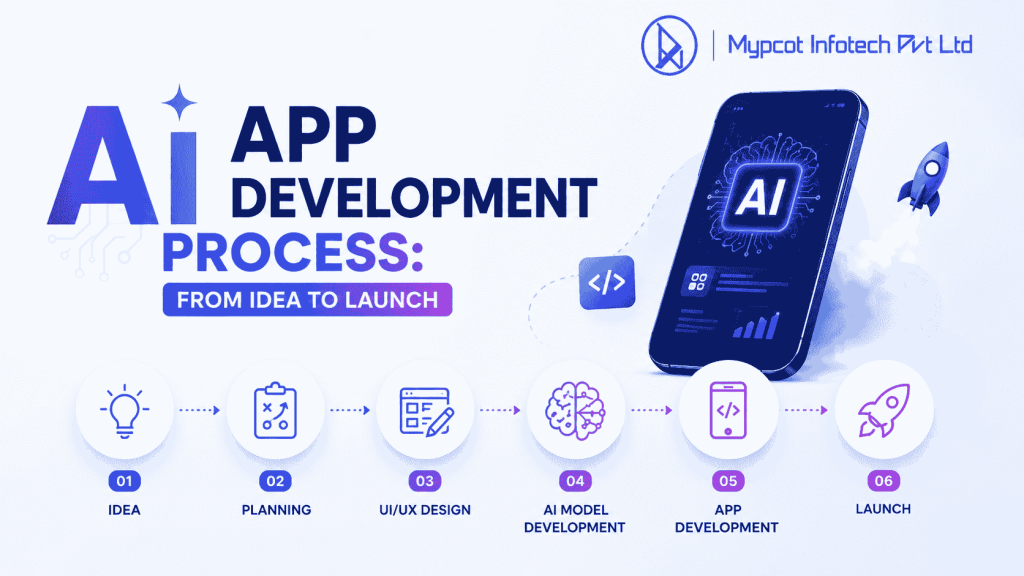
AI App Development Process: From Idea to Launch

AI App Development Process From Idea to Launch

Building an AI-powered app can start with just a simple idea, but converting that idea into a reliable product really takes more careful planning. It includes much more than connecting an AI API or even adding a chatbot to the screen. 

Everything, from understanding the business problem and choosing the right tech stack to preparing data, developing the app, testing it, and then improving after launch, every stage has an essential role to play. So, a clear AI app development process helps businesses understand what exactly needs to be developed, where AI can add its real value, and what resources the project may require. 

No matter if you’re running a startup and exploring an AI product or an established business adding smart features to your existing app, understanding these stages helps you plan the project, budget, and expectations more effectively. 

Understanding the AI App Development Process

AI app development combines traditional mobile app development with intelligent capabilities that make apps more adaptive and context-aware. Rather than following just fixed rules, AI-powered apps can understand user intent, process natural language, analyze data, and improve their responses over time. 

These apps can:

  • Understand text or voice-based user queries
  • Identify patterns in user behavior
  • Make predictions using historical and real-time data
  • Automate repetitive or decision-based tasks
  • Deliver personalized content and recommendations
  • Adapt based on user interactions

Unlike traditional applications, AI applications are data-driven. It means the same feature can produce different outputs for different users based on their context, preferences, or even history. 

However, building AI apps adds extra complexity, including:

  • Data quality: Poor or biased data can reduce accuracy.
  • Security & privacy: Sensitive data must be protected and compliant.
  • Model accuracy: AI outputs need continuous testing and validation.
  • Scalability: Systems must handle growing users and data.
  • Performance: AI processing should not slow down the app.
  • Continuous updates: Models often need retraining or fine-tuning.

All these elements must work smoothly with the app’s design and backend, along with APIs, in order to ensure a seamless user experience. Here, the goal isn’t just to add AI; it’s to integrate it ina such a way that seems natural, fast, and useful. 

Due to this complexity, a structured development process is really essential- from selecting the right use case and technology to building, testing, and deploying the solution.

Define the App idea and Business Objective

It’s important to have a clear idea of what the app should do before selecting an AI technology, and before beginning development. A strong idea needs to focus on the problem rather than simply doing what can be done with AI. 

First, begin by answering some simple questions:

  • What is the challenge that the app will address?
  • Who will be using the product?
  • What do users need to be able to do with the app?
  • What is the business purpose of this?
  • What will you use to determine the success of the app?

If you have obvious answers at this point, it will help the development team determine which features are necessary and which are not; it will avoid building unnecessary features, and it will help the development team create an application that will meet the needs of a real user or business.

Identify AI Features and Use Cases

Once the major objective is clear, the next step is to identify where AI can genuinely improve the application. The right use case relies on what exactly your users need and what the business really wants to achieve. 

Common AI use cases include:

  • Personalized recommendations
  • AI-powered search
  • Voice recognition
  • Predictive analytics
  • Content generation
  • Automated customer support

The goal should not be to add as many AI features as possible. If simple, rule-based features can solve a problem more effectively, there may be no need to introduce AI. So, focusing on useful applications of AI can keep the product simpler, more reliable, and easier to scale. 

Choose the Right AI Technology and Development Stack

Once the use cases are established, the development team can readily decide on how the application should be developed. Depending on the specific requirements, the project can use technologies like machine learning, natural language processing, computer vision, generative AI, or recommendation systems. 

The way in which the app is developed for the mobile platform should be taken into account as well. The business can opt for a cross-platform framework like React Native or opt for native development on both Android and iOS. There are a number of factors to consider in determining which is the right one:

  • App complexity
  • Target platforms and devices
  • AI integration requirements
  • Development budget
  • Scalability
  • Backend requirements
  • Future product plans

At this stage, it is crucial to select the right technology and avoid rework and make future application maintenance easier.

Plan the App Architecture and User Experience

A great model will not automatically create a great app. You still need an interface that feels simple and intuitive. At this stage the team works on the structure of your app besides wireframes and UI or ux design. You decide how users will interact with the AI and where intelligent features will appear.

Prepare and integrate data for AI models

Data is one of the most important parts of AI development. If you are building a custom solution, the model needs relevant and usable data to learn from. That might involve collecting, cleaning, and labeling data sets. Your team also needs to think about how the data will move through the application.

Develop and Train the AI Model

Now the AI component itself can be developed. Not every AI app needs a model built from scratch; in many cases, existing models or API might be enough. For more specialized applications, however, the development team might need to train or fine-tune a model using relevant data. This stage can involve several rounds of testing and adjustment. AI is not always a simple build-once-and-launch process.

Build the mobile app and integrate AI

Once your product architecture and AI approach are established, mobile development moves forward. You need to build the core functionality, including user registration and profiles, dashboards, payments, notifications, search content and other required features. The AI functionality is integrated into these workflows.

Test AI performance, security, and app functionality

Testing an AI app involves way more than just checking the buttons. The development team needs to test the application itself and the functionality of AI. This can include functional testing, AI performance testing, security testing, performance testing, and device testing. Mypcot’s Mobile development processes include testing and continuous delivery, with multiple test scenarios used before final delivery.

Deploy the AI app

Once testing is complete and the product is approved, it is time to launch. For a mobile application, this basically means preparing the app for the relevant app stores and publishing it for users. But launch day is not the end of the development process. It is actually the point where the application starts receiving real-world usage, which can reveal things that were difficult to identify during development. User behaviour feedback and performance issues can all provide useful information for future improvements.

Monitor, Maintain, and Improve the AI app

AI apps need ongoing attention after launch. Operating systems change and even user expectations change. Your business might also introduce new requirements. That means post-launch work includes fixing bugs, improving app performance, updating AI models, monitoring AI responses, and adding new features. This ongoing process is especially particular for AI because performance can change as user behaviour and data patterns change.

How much does AI app development cost?

There is no standard price for an AI app because the cost depends on the complexity of the product. A basic application using existing AI services might require a relatively modest investment. A more advanced application involving custom AI models and complex backend systems can cost significantly more.

The main cost factors usually include:

  • UI/UX design
  • Mobile development
  • Backend development
  • AI model development or integration
  • Data preparation
  • APIs and third-party services
  • Testing
  • Cloud infrastructure
  • Security
  • Post-launch maintenance

Why choose an AI app development company?

The process of creating an AI application includes mobile development, backend systems, integration with AI, managing data, security measures, testing, and deployment. An experienced AI application development company combines all these skills to develop a trustworthy product without dealing with the technicalities of all the facets individually.

Key Reasons to Work with an AI App Development Company:

  1. Choose the AI Method That’s Right for You

Determine when and where AI can actually help address a business challenge rather than unnecessary bells and whistles.

  1. Select Suitable Technologies

Select appropriate AI tools, APIs, frameworks, and development methodology for specific projects and budgets.

  1. Integrate AI Properly

Connect AI integrates seamlessly into the app’s front and back end as well as its user workflows, making them feel like part of the product.

  1. Scale for Security

Secure user information and design an architecture that can support expansion of users, data, and features.

  1. Test the Complete Product

Test the app’s functionality, AI responses, performance, security, integrations, and device compatibility.

  1. Improve After Launch

Track performance, resolve problems, enhance AI capabilities, and introduce new functionality by analyzing the feedback of real users.

Conclusion

AI app development is a step-by-step process where every decision, from the initial idea and AI use case to technology, data, testing, and post-launch support, can affect the final product. By applying a thoughtful approach, development effort can be controlled while maintaining the usefulness, security, and scalability of the app. 

It’s worth considering first that the most valuable features are to be first, as this helps to test the concept before the project moves forward. When it comes to developing a mobile app with AI, Mypcot Infotech can help you transform your needs into robust software designed for users and scalability.

FAQs

  1. How long does it take to develop an AI app?

The timeline basically depends on the complexity of features, AI requirements and integration of the app. A basic app might take a few months, while a complex application with custom models can take longer.

  1. What are the main stages of AI app development?

The main stages include defining the idea, identifying AI use cases, selecting technology, planning architecture and preparing data while developing the AI model.

  1. How much does it cost to develop an AI-powered app?

The cost basically varies depending on the project. An AI API integration into a simple application can cost much less than developing a complex app with custom AI models and advanced data processing.

  1. Which AI technologies are used in mobile app development?

Common technologies include machine learning, natural language processing, computer vision and generative AI.

  1. Why should businesses work with an AI app development company?

An experienced app development company can bring together AI mobile development, backend, UI UX testing and deployment expertise. This can make the development process more structured

Related Articles

Leave a Comment