We have all used apps that seem to know exactly what we need before we ask. Like, a shopping app suggests the right product, a streaming app finds something worth watching, and a chatbot answers a question in seconds.
Here, what feels effortless to the user is the result of careful work behind the screen. AI app development in Mumbai involves much more than adding an AI feature.
It demands the right data, models, backend, security, along with user experience in order to turn an ordinary app into something that can understand, respond, and deliver real value.
Table of Contents
ToggleUnderstanding AI App Development
A traditional App has fixed rules: it takes an input from the user and gives back an expected output. AI app development can enhance an app’s context-awareness by enabling it to learn from data, detect patterns, comprehend language, create content, forecast outcomes, or automate processes.
For example, a regular shopping app may show products based on selected categories, while an AI-powered app can study searches, purchases, and preferences to provide personalized recommendations.
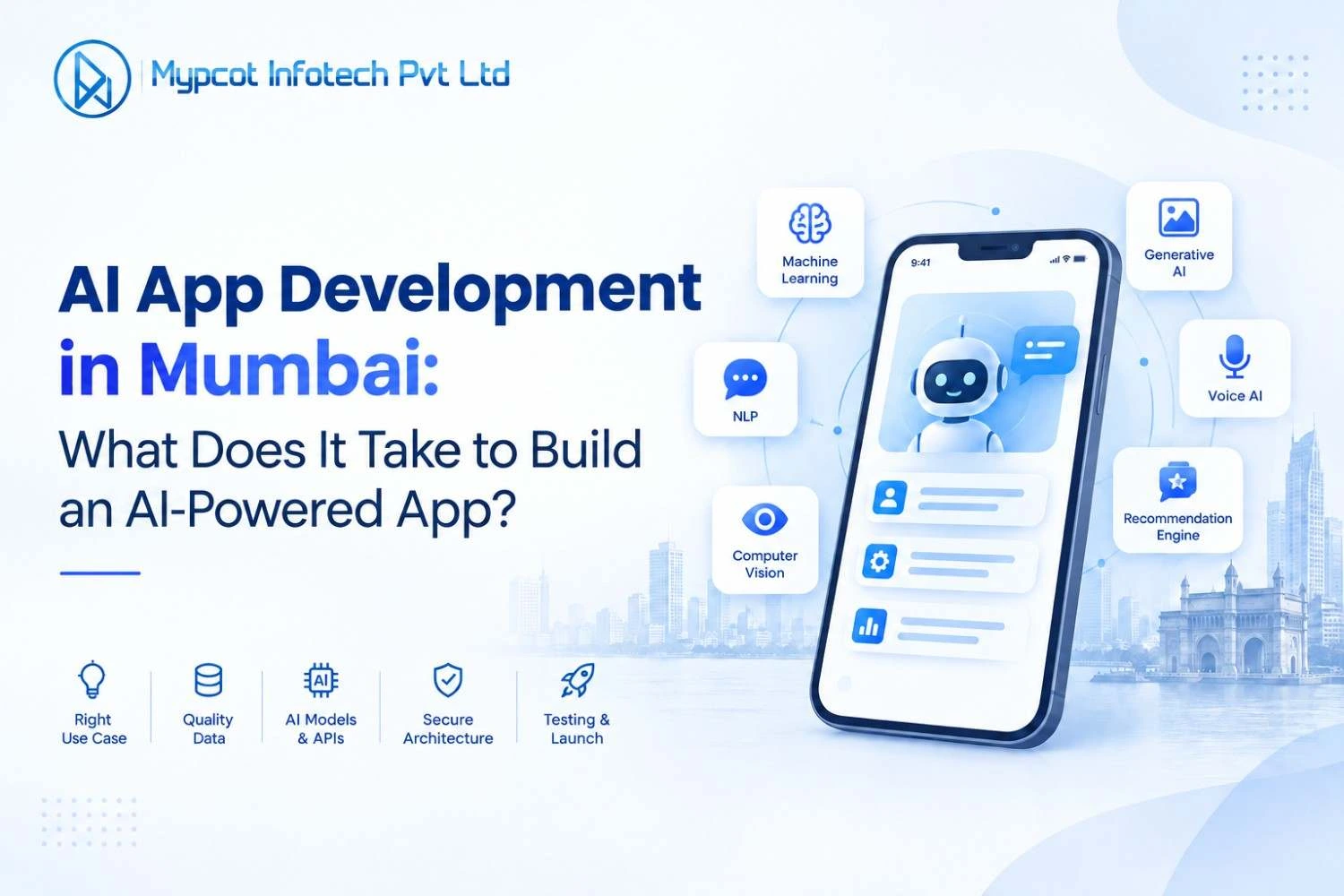
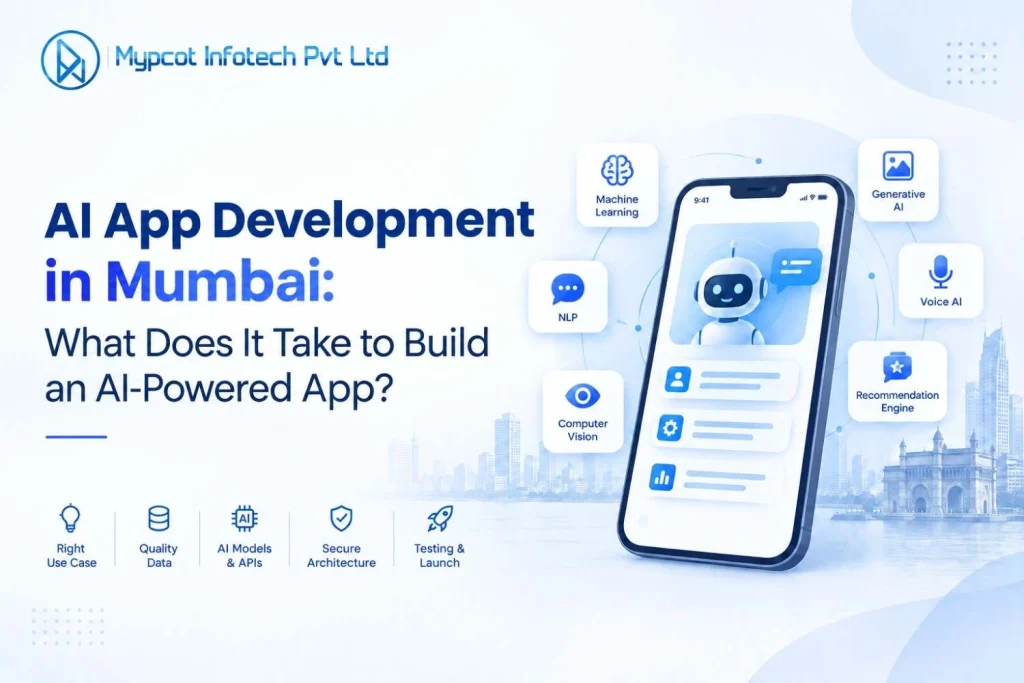
Depending on the scenario, they can leverage machine learning, generative AI, NLP, computer vision, recommendation engines, or AI APIs. The key is to select the appropriate technology for the actual problem. It’s not about adding AI to an app, but making it more useful, accurate, personalized, or efficient.
| Traditional App | AI-Powered App |
| Functions based on predefined rules | Functions based on data and context |
| A single workflow for multiple users | One workflow can adapt to different users |
| Data is manually entered into the system | Data can be captured through intelligent automation |
| Static recommendations | Personalized recommendations |
Intelligent mobile applications can use data to make their responses more relevant and context-aware, whereas traditional apps act in response to instructions.
What Types of AI Features Can Be Built Into a Mobile App?
AI can do far more than power a chatbot. When it’s matched with the right use case, it can truly help an app to understand users, automate repetitive work, identify patterns, as well as deliver more relevant experiences:
AI Chatbots and Virtual Assistants
With AI chatbot development, apps can handle FAQs, custom queries, and product guidance, appointment requests, and basic support without even making users search through multiple screens.
AI assistants can also qualify leads and provide conversational, context-based responses.
Personalized Recommendations
Recommendation engines analyze user behaviour, preferences, searches, as well as previous activity in order to suggest relevant products or content.
E-commerce apps can recommend products, OTT platforms can suggest shows, and learning apps can even personalize courses or study materials.
Predictive Analytics
Predictive analytics uses historical and real-time data to find patterns and estimate what may happen next.
Businesses can use it to forecast demand, understand customer behaviour, predict churn, estimate sales, and identify operational issues before even they become costly.
Computer Vision
Computer vision app development allows applications to interpret visual information. Common applications involve image recognition, document scanning, visual search, quality inspection, and object detection. In suitable use cases, it can support face recognition and verification.
Generative AI
Generative AI app development allows applications to create new content rather than simply retrieving existing information.
It can also power AI assistants, generate text or images, summarize documents, create personalized responses, and help users complete content-heavy tasks faster.
Voice-Based AI
Voice technology can turn spoken language into useful actions through speech recognition, transcription, voice commands, and conversational interfaces. This can make applications faster to use and more accessible, particularly when typing is inconvenient.
The right feature depends on the problem. A strong AI application uses intelligence where it improves the user experience or produces a measurable business benefit, rather than adding AI simply for the sake of it.
What Does It Take to Build an AI-Powered App?
A good AI app is built around a purpose, not just a technology. A few important decisions shape how well it performs.
1. Define the Business Problem
The first step is to grasp the user, the problem, and the desired outcome of the app. AI must also have a specific function and measurable goal. In cases where a simple feature might solve the problem more effectively, AI may not be needed.
2. Choose the Right AI Use Case
The technology is determined by the requirement. AI tools can be used to create content, give directions to AI assistants, make predictions, process language, and analyze images.
3. Prepare the Data
Reliable data is essential to reliable AI. Information relevant to the inquiry must be gathered, cleaned, processed and securely stored with appropriate access and privacy controls.
4. Select the Model or API
AI APIs, open-source models, or custom-trained machine learning models are available for businesses to select from. The decision should be based on accuracy, response time, scalability, and cost.
5. Plan the Architecture
Big AI apps typically tie the interface, back end, and AI layer together with the database and external APIs. These components remain secure, responsive, and scalable with a well-planned architecture.
6. Test Before Launch
AI must be tested to ensure it is accurate, works on unusual inputs, has a reasonable response time, is secure, and has a user-friendly experience. The objective isn’t simply to get the AI to execute its functions, but to make it do them reliably.
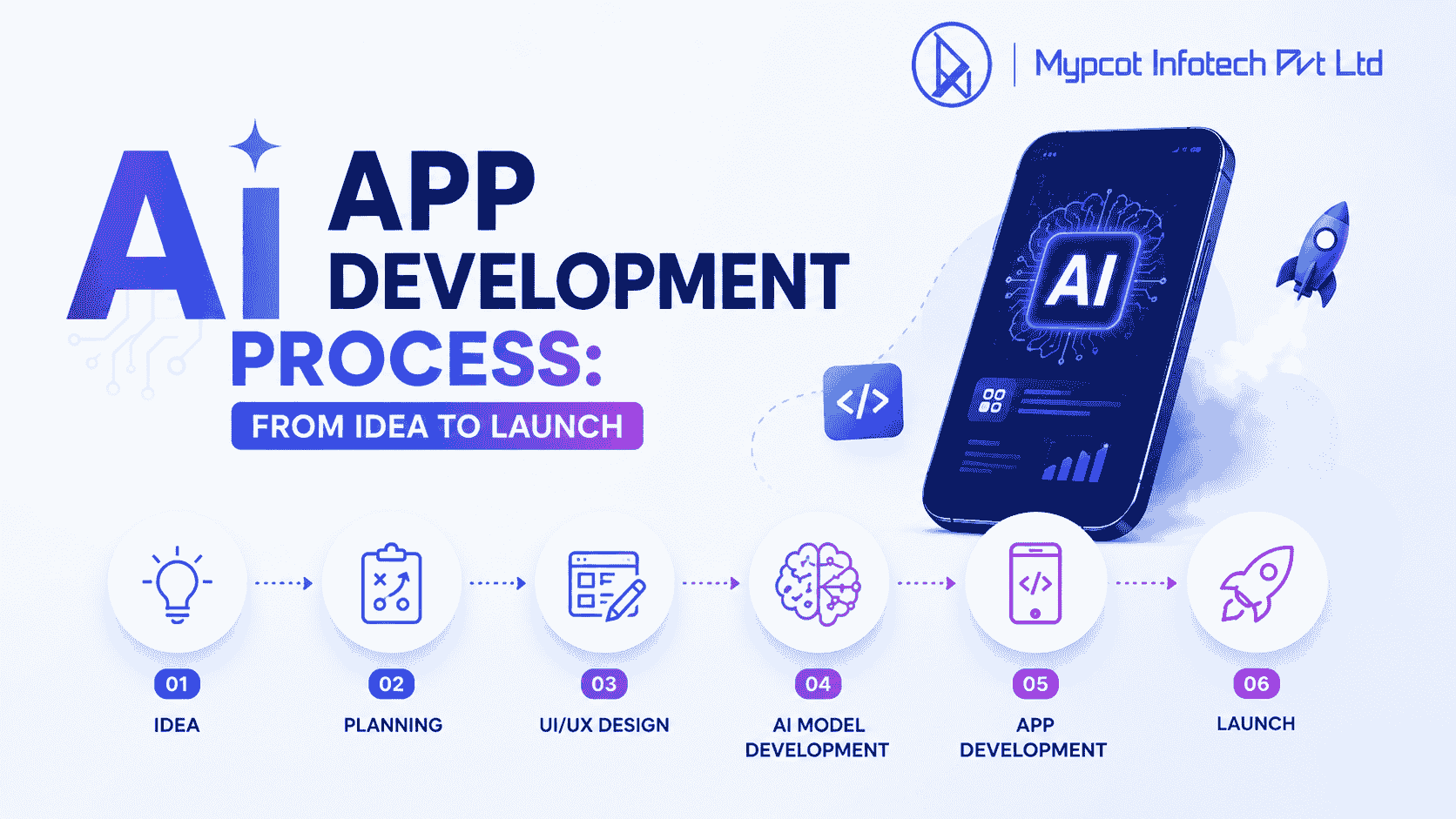
AI App Development Process: From Idea to Launch
A clear development process will guide an idea to an actual product and eliminate unnecessary development and technical risks.
- Discovery and Requirements Analysis
Set business objectives, target users, key business requirements, and the feasibility of AI before the development process starts. This sets the groundwork for what the app does need to do.
- UI/UX and App Prototyping
There is a need for careful design of AI interactions. Consider early the chat interface, generated responses, loading states, confidence indicators and human review options.
- MVP Development
Rather than rolling out all the features of AI, begin with one or two valuable additions. An MVP is used to test the concept, collect user feedback, and identify future enhancements. Here’s where AI App Development Services can be beneficial.
- Backend Development and AI Integration.
Integrate AI with the back-end, databases, authentication, APIs and cloud infrastructure. Security in data handling and scalability for future growth is needed.
- Test and Quality Assurance
Try out the functionality, AI answers, performance, security, usability and weird inputs. AI testing is crucial because if a system is technically correct, it may give unreliable results.
- Deployment and Monitoring
Launch is not the end of the road. Track AI performance, errors, API usage, user feedback, and response quality to identify issues and make continuous improvements to the application.
Conclusion
A promising AI idea is only the starting point. To make it a functional product, decisions need to be made about the use case, data, AI tech, and app architecture, as well as its user experience. Mypcot Infotech employs these stages to guide businesses towards making concepts a reality in AI applications.
The emphasis is on building an app that has a real purpose, from integrating AI APIs and creating intelligent features to developing the backend and refining the user experience.
Mumbai AI app development companies will be able to collaborate with Mypcot Infotech to craft AI-driven solutions that are both scalable and practical, meeting the unique needs of their business.