A useful AI system should do more than just understand a request. It should also know what information to find, which tools to use, what action exactly to take, and when to ask a person for help. And that shift from generating answers to completing tasks is what actually makes AI agents different.
By combining large language models with business data, APIs, memory, along with workflow logic, they can manage multi-step processes across different systems.
These capabilities are creating practical AI agent use cases in customer, sales, finance, research, as well as operations.
Table of Contents
ToggleWhat Are AI Agents and How Are They Different From Chatbots?
Actually, a real difference between a chatbot and an AI agent isn’t how naturally they can talk. It’s exactly what happens after the conversation. A chatbot has the potential to understand a request and provide information. On the other hand, an AI agent takes that request as a goal, decides what information it exactly needs, chooses the right tools, performs several actions, and works toward completing the task.
What Is an AI Agent?
An AI agent is a goal-oriented system that combines an AI model with reasoning, planning, memory, tools, APIs, and workflow logic. It can decompose a complex request into smaller stages, communicate with external systems and assess the outcomes, and repeat until the request is finished or requires human intervention.
For example, instead of just answering a query about the refund, one of the agents can verify the order, check the refund policy, get the customer’s details, and begin the process of making the refund. If there are exceptions, the agent can then pass the case to a live person.
AI Agent vs Chatbot
| Capability | Chatbot | AI Agent |
| Understand a request | ✓ | ✓ |
| Retrieve information | ✓ | ✓ |
| Use tools and APIs | Limited | ✓ |
| Plan multiple actions | Limited | ✓ |
| Change or update systems | Limited | ✓ |
| Complete a workflow | Limited | ✓ |
How Do AI Agents Automate Business Workflows?
AI agents automate workflows by understanding business goals and determining the steps needed to complete them.
They can retrieve information, use connected tools, take actions, verify results, and involve a human when required. Now, this makes AI workflow automation particularly useful for complex, multi-step business processes.
Understanding the User’s Intent
An agent first identifies what the user is actually trying to accomplish. It utilizes the request, available context, business data, and workflow rules in order to determine the appropriate task.
Planning the Next Steps
Once the goal is clear, the agent decides what needs to happen and in what order. Unlike fixed automation, it can adapt its next step based on information returned during the workflow.
Connecting With Business Tools
AI agents can interact with systems like:
- These are CRM and ERP platforms.CRM/ERP platforms.
- Helpdesk system and database.
- Email and calendar
- Payment systems
- Internal business APIs
This connection enables AI agents for business to interact with actual data and take actions, rather than simply providing responses.
Taking and Verifying Actions
An AI agent should not execute an action simply because an LLM suggests it. Production AI agent automation needs permissions; it should stop and escalate rather than make an unchecked decision.
After execution, the agent should verify the result. If something falls or falls outside its permissions, it should stop and escalate rather than make an unchecked decision.
15 AI Agent Use Cases for Businesses
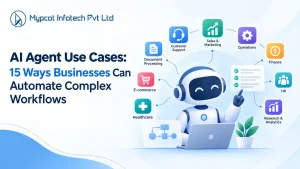
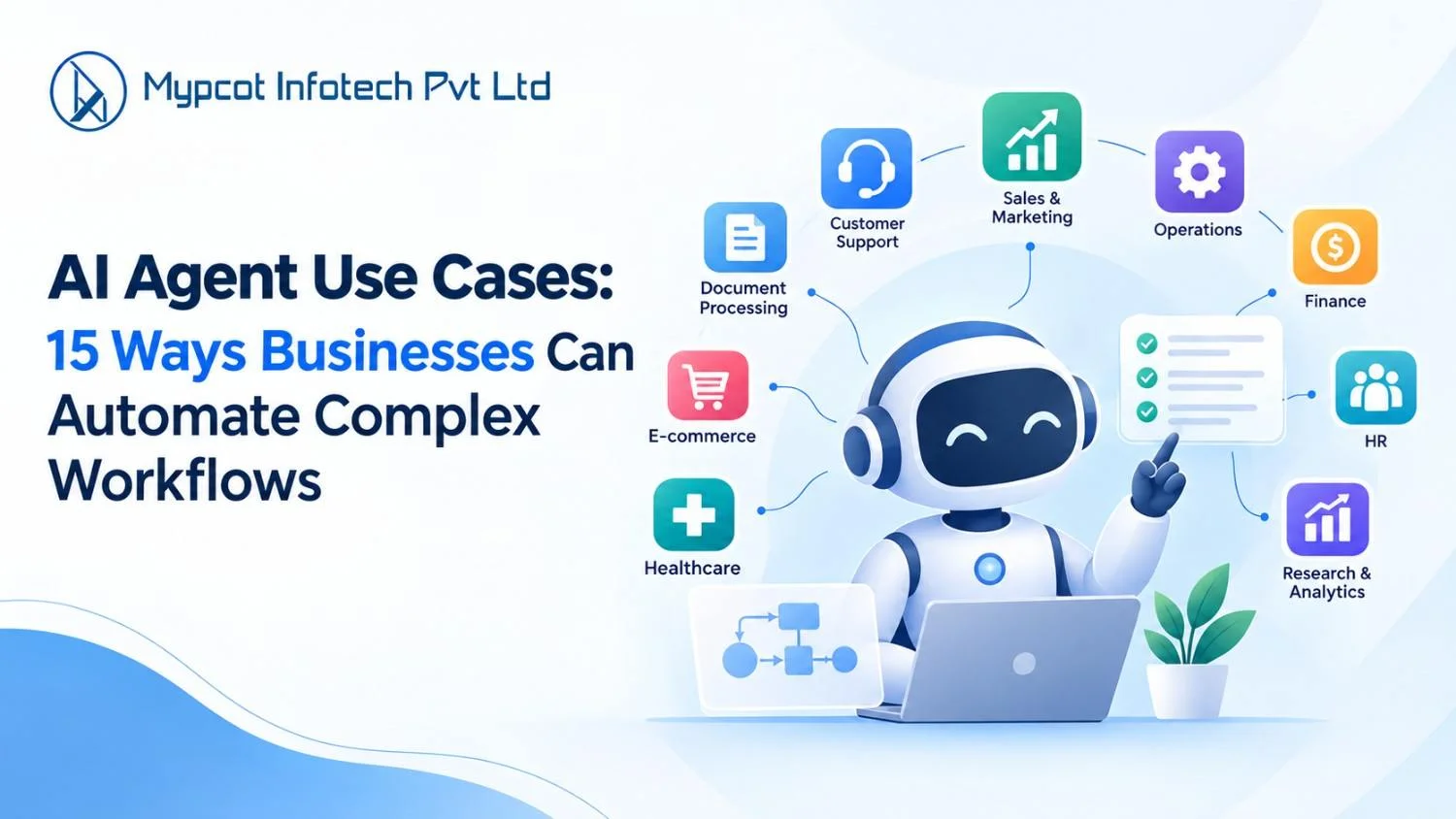
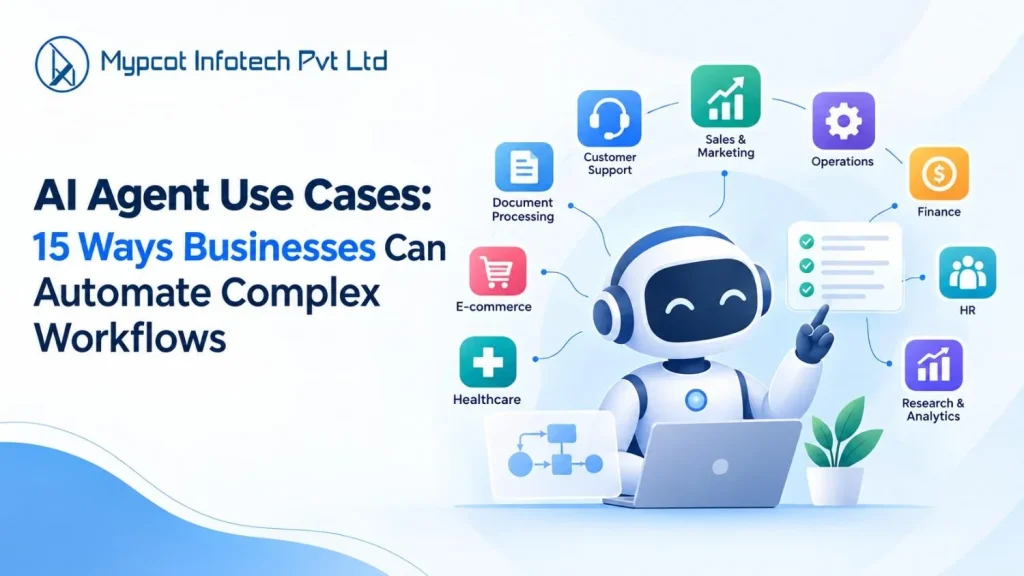
AI agents become valuable when they connect decisions with real business actions. These AI agent use cases show where businesses can automate multi-step workflows while keeping important decisions under human control.
1. Customer Support and Service Agents
An AI customer service agent can comprehend requests, access customer information, review policies, resolve customer problems, and perform approved actions.
It can be integrated with CRM, helpdesk, order management, and internal APIs to resolve simple issues, and more complex ones will be transferred to human representatives.
2. Sales and Lead Qualification Agents
Generate leads and classify them.
- Research companies
- Update CRM records
- Schedule follow-ups
- Qualified leads to sales teams
Agents can minimize repetitive sales administration by integrating CRM, email, calendar and research.
3. IT Helpdesk and Employee Support Agents
IT agents can categorize tickets, reply to troubleshooting questions, look into known issues, and provide status updates.
They are able to communicate with helpdesks, internal information systems, identity systems, and IT management equipment. Access modifications and/or infrastructure needs to be validated and approved appropriately for sensitive access.
4. Document Processing and Data Extraction
When the goal is to process documents, AI agents can go beyond just extracting text and enable a full workflow.
They can be used to pull data out, validate data, test out business rules, catch exceptions, and move verified data into ERP systems, accounting, or databases.
5. Research and Competitive Intelligence Agents
Research agents can collect data from authorized sources, analyse data, track changes and produce reports.
Useful applications include:
- Price and product monitoring of competitors.Competitor pricing and product tracking.
- Industry research
- Company announcement tracking
- Market trend analysis
Source verification and human oversight are still significant for research that is critical to business.
6. E-commerce Shopping and Product Recommendation Agents
An eCommerce agent can have understanding of user requirements, such as “Find a laptop for video editing under ₹80,000”, narrow down the products, compare features, and check whether they are in stock.
It also integrates with product, inventory and order systems, making it possible to track orders and post-purchase inquiries as well.
A finance agent can take care of repetitive accounts payable processes such as:
- Invoice extraction
- Purchase-order matching
- Duplicate detection
- Exception identification
- Approval routing
These workflows can be made more efficient with ERP and accounting integrations and payments should be subject to approval and audit processes.
7. HR and Recruitment Agents
Recruitment agents can handle administrative tasks such as candidate data extraction, application organisation, interview scheduling, candidate communication, and ATS updates.
They can reduce recruitment workload while keeping candidate selection and sensitive employment decisions under human review.
8. Marketing Operations Agents
Marketing agents can set up research, segmentation, campaign analysis, and reporting.
They can connect CRM, analytics, email marketing, advertising, and SEO platforms to transfer data across platforms and get ready for the next steps. Humans can still have control over messaging, budgets and campaign approval.
9. Healthcare Administrative Workflow Agents
In the healthcare industry, AI agent applications can be applied to:
- Appointment scheduling
- Patient reminders
- Document organisation
- Insurance coordination
- Report summarisation
- Follow-up management
Controls, like those for privacy, role access, audit trails, and manual review, are essential for critical workflows that involve sensitive data.
10. Supply Chain and Inventory Agents
Supply chain agents can monitor inventory, track shipments, identify exceptions, and coordinate replenishment.
Once the stock level hits a predetermined limit, an agent can verify purchase orders, assess supplier information, create a purchase order request, and submit it for approval.
11. Legal and Contract Workflow Agents
Legal workflow agents can assist with:
- Contract and clause search
- Information extraction
- Document comparison
- Renewal tracking
- Review routing
They help organise large document collections, while legal interpretation and high-impact decisions remain with qualified professionals.
12. Travel and Hospitality Agents
Travel agents are able to recognize preferences, compare, create itineraries, check availability, bookings, and changes.
This is a practical application of AI workflow automation, as integrations with booking systems, calendars, payment platforms, and CRM tools make it easy to see how it can be applied.
13. Internal Knowledge and Employee Productivity Agents
Internal AI agents can access company policies, SOPs, project documentation, and knowledge bases.
With RAG, embeddings, vector databases, and access controls, an agent can satisfy employee access requirements to access relevant information. It can also summarise projects and provide guidance for employees on internal processes.
14. Operations and Workflow Orchestration Agents
Advanced use cases of AI agents involve orchestrating multiple systems across a single workflow such as CRM, ERP, databases, email, analytics, and business APIs.
The agent can get information and access tools, analyze the results, and decide on the next allowed action. Again, AI agent development can be particularly useful, allowing businesses to integrate their current systems with an intelligent orchestration layer.
Conclusion
AI agents can turn complex, repetitive processes into connected, intelligent workflows, from customer support and sales to finance and operations.
Different AI agents have different use cases that work best for your processes, systems, data, and level of human control. When it comes to automation, AI agents can be implemented practically without compromising control, provided they have the right architecture.
Try custom AI agent development with Mypcot Infotech to create AI-driven workflows that meet your business requirements.